
Effective call center scheduling represents one of the most critical operational challenges facing contact center managers in 2026. The balance between maintaining service levels, controlling costs, and ensuring agent satisfaction requires sophisticated planning, accurate forecasting, and continuous optimization. As customer expectations rise and communication channels multiply, the complexity of scheduling decisions has increased exponentially, demanding new approaches that blend data analytics, flexible workforce models, and human-centered policies.
Understanding Modern Call Center Scheduling Fundamentals
Call center scheduling has evolved significantly from simple spreadsheet-based shift assignments to sophisticated workforce management systems that leverage artificial intelligence and real-time data. At its core, scheduling involves aligning agent availability with predicted contact volumes across all channels while respecting labor regulations, agent preferences, and budget constraints.
The foundation of any scheduling system begins with accurate forecasting. Historical data on call volumes, average handle times, and seasonal patterns inform predictions about future staffing requirements. These forecasts must account for multiple variables including day of week, time of day, promotional campaigns, product launches, and external events that influence customer contact behavior.

Modern contact center workforce management requires integration across multiple systems. CRM platforms, ticketing systems, and communication channels must feed data into workforce management tools that generate scheduling recommendations. For operations like inbound call center services, this integration becomes particularly crucial when managing unpredictable volume spikes.
Key Scheduling Metrics and Calculations
Successful call center scheduling depends on mastering several core metrics that drive staffing decisions:
- Service Level: The percentage of calls answered within a target time threshold (typically 80% in 20 seconds)
- Occupancy Rate: The percentage of logged-in time agents spend handling contacts versus waiting
- Shrinkage: Time agents are paid but unavailable for contacts (breaks, training, meetings, absences)
- Adherence: How closely agents follow their assigned schedules
- Average Speed of Answer (ASA): Mean time customers wait before reaching an agent
The Erlang C formula remains fundamental for calculating agent requirements based on call volume, average handle time, and target service level. However, modern scheduling extends beyond this basic calculation to incorporate multichannel interactions, variable handle times, and agent skill requirements.
| Metric | Target Range | Impact on Scheduling |
|---|---|---|
| Service Level | 80-90% | Determines minimum staffing requirements |
| Occupancy | 75-85% | Balances efficiency with agent burnout risk |
| Shrinkage | 25-35% | Increases actual headcount needed |
| Schedule Adherence | 90-95% | Affects forecast accuracy and coverage |
Forecasting Techniques for Accurate Call Center Scheduling
Accurate forecasting forms the backbone of effective call center scheduling. Without reliable volume predictions, even the most sophisticated scheduling algorithms will fail to deliver optimal results. Modern forecasting approaches combine statistical methods with machine learning to capture complex patterns in customer contact behavior.
Time-series analysis examines historical patterns to identify trends, seasonality, and cyclical variations. A typical forecasting model analyzes at least 12 months of historical data to account for annual cycles, though two years provides greater reliability. Daily, weekly, and monthly patterns must all be identified and incorporated into predictions.
Advanced forecasting models incorporate external variables that influence contact volumes. Marketing campaigns, product releases, billing cycles, weather events, and competitive actions can all drive significant volume fluctuations. Integrating these factors into forecasting models improves accuracy substantially compared to purely historical approaches.
Multivariate Forecasting for Complex Operations
For contact centers handling multiple channels and services, multivariate forecasting becomes essential. Outbound call center services require different forecasting approaches than inbound operations, as volumes can be partially controlled through campaign pacing and list management.
The Society of Workforce Planning Professionals guidance on outbound forecasting emphasizes the importance of coordinating scheduling with campaign objectives and list availability. Outbound scheduling must balance productivity targets with customer contact preferences and regulatory compliance around calling hours.
Machine learning algorithms can identify non-linear patterns and interactions between variables that traditional statistical methods miss. Neural networks, random forests, and gradient boosting models have demonstrated superior accuracy for contact centers with complex, volatile demand patterns. These approaches require substantial historical data and technical expertise but deliver significant improvements in forecast accuracy.
Building Effective Shift Plans and Rotations
Once volume forecasts are established, the next challenge involves creating shift plans that match agent availability to predicted demand while respecting labor regulations and agent preferences. This optimization problem involves thousands of variables and constraints, making it impossible to solve manually for all but the smallest operations.
Shift planning begins by defining the scheduling interval, typically 15 or 30 minutes, which determines the granularity of staffing adjustments. Shorter intervals enable more precise matching of staff to demand but increase schedule complexity and make agent adherence more challenging.
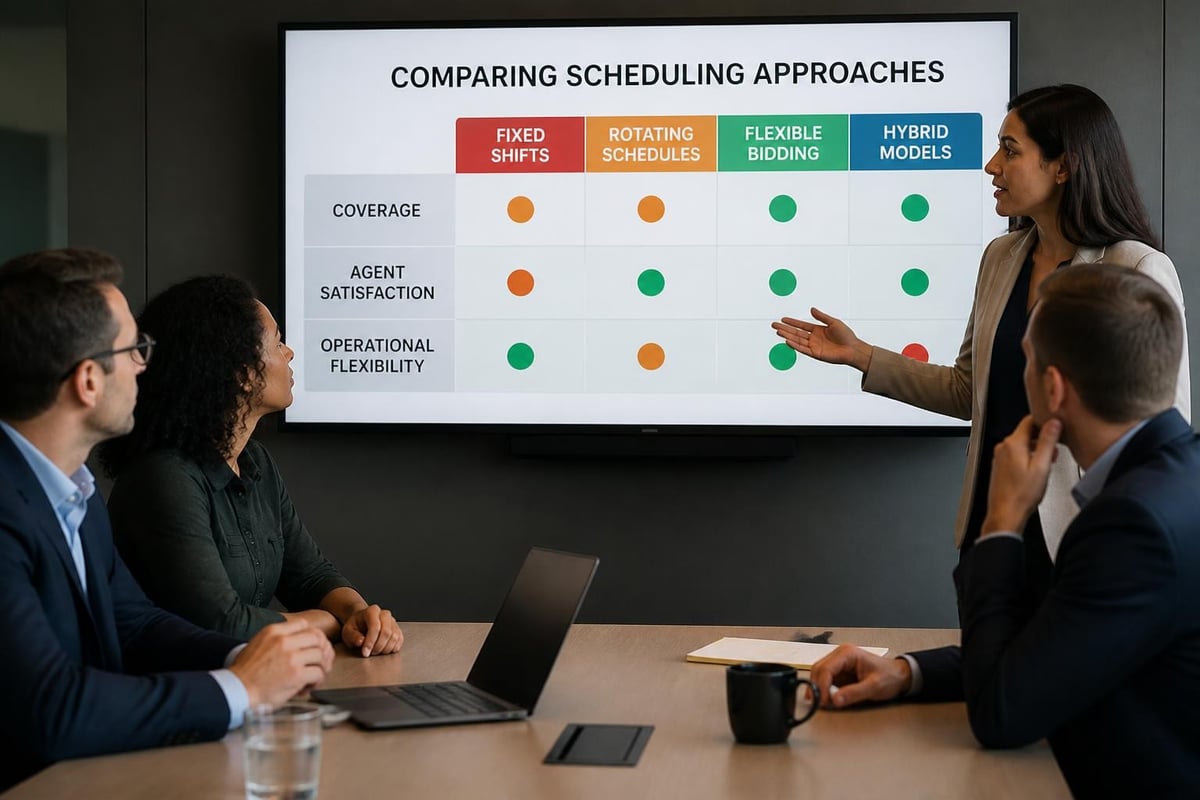
Traditional fixed shifts provide predictability for agents but limit scheduling flexibility. Five eight-hour shifts covering a 40-hour workweek represent the standard approach, though many centers now employ more varied shift patterns including:
- Split shifts: Two shorter work periods separated by an extended break
- Compressed workweeks: Longer daily shifts over fewer days (e.g., four 10-hour days)
- Staggered starts: Shifts beginning at 15-30 minute intervals to match staffing curves
- Flexible shifts: Agents select from available shifts within defined parameters
- On-call arrangements: Agents available to work during high-volume periods
Research on work scheduling practices and employee well-being demonstrates that predictable schedules with adequate advance notice significantly improve agent satisfaction and retention. Unpredictable last-minute schedule changes increase stress, turnover, and absenteeism, ultimately undermining scheduling effectiveness.
Rotation Patterns and Fairness
For operations requiring 24/7 coverage or weekend shifts, rotation patterns distribute less desirable time slots fairly across the team. Common rotation approaches include:
- Fixed rotations: Agents permanently assigned to specific shifts based on seniority or preference
- Weekly rotations: Shifts change each week following a predetermined pattern
- Bidding systems: Agents select preferred shifts based on seniority or performance
- Self-scheduling: Teams collectively manage their schedules within management-defined constraints
The ICMI research on workforce management for small and midsize contact centers highlights that even smaller operations benefit from structured rotation policies that balance operational requirements with agent preferences.
Technology Platforms for Call Center Scheduling Optimization
Modern workforce management platforms automate much of the scheduling process while providing tools for scenario analysis, real-time adjustments, and performance tracking. These systems integrate forecasting, scheduling, intraday management, and reporting into unified platforms that significantly improve efficiency compared to manual approaches.
Leading workforce management solutions offer automated scheduling engines that generate optimal shift assignments based on forecast demand, agent skills, availability preferences, and labor rules. These engines evaluate thousands of possible schedule combinations to identify solutions that minimize cost while meeting service level targets.
According to the CCMA Contact Centre Technology Report 2025, integration between workforce management platforms and other contact center systems has become a top priority. Seamless data flow between ACD systems, CRM platforms, and WFM tools enables more accurate forecasting and responsive schedule adjustments.
| WFM Platform Capability | Business Impact | Implementation Complexity |
|---|---|---|
| Automated forecasting | 15-25% improved accuracy | Medium |
| Optimized scheduling | 10-20% reduced labor cost | High |
| Intraday management | 5-10% improved service levels | Low |
| Agent self-service | 20-30% reduced admin time | Low |
| Skills-based routing integration | 15-25% improved first-call resolution | High |
The HELION platform demonstrates how integrated technology stacks can support workforce management alongside CRM, ticketing, and communication tools. By consolidating data from multiple sources, such platforms enable more informed scheduling decisions and reduce the administrative burden of managing disparate systems.
AI and Machine Learning in Scheduling
Artificial intelligence is transforming call center scheduling through several applications. Predictive analytics identify agents at risk of absenteeism, allowing proactive schedule adjustments. Natural language processing analyzes customer sentiment and interaction complexity to improve handle time forecasts. Reinforcement learning algorithms optimize shift patterns over time by learning from outcomes.
Recent research on dynamic and flexible personnel scheduling explores how AI can manage complex on-call arrangements and adapt schedules in real-time based on emerging patterns. While still largely experimental, these approaches show promise for operations with highly variable demand.

Managing Skill-Based Routing and Scheduling
As contact centers support increasingly complex products and services across multiple channels, skill-based routing has become standard practice. Agents possess varying capabilities in languages, product knowledge, technical expertise, and channel proficiency. Effective call center scheduling must account for these skill distributions to ensure adequate coverage across all required competencies.
Skill-based scheduling complexity grows exponentially with the number of distinct skills and skill levels. A center supporting three languages, five product lines, and four channels could theoretically require scheduling for dozens of skill combinations. Practical implementations group related skills and establish minimum service levels for critical skill categories.
Multi-skill agents provide scheduling flexibility but require careful capacity planning. An agent qualified for multiple queues might be scheduled based on their primary skill but available to handle overflow in secondary skills. Workforce management systems must track skill-level requirements separately while recognizing that agents can flex across queues.
Balancing Specialization and Flexibility
Organizations face a fundamental tradeoff between agent specialization and scheduling flexibility. Highly specialized agents deliver superior customer experiences in their domain but create scheduling rigidity and potential coverage gaps during absences. Generalist agents provide maximum flexibility but may require longer handle times and deliver less consistent quality.
Most contact centers adopt a hybrid approach with a core of multi-skilled generalists supplemented by specialists for complex technical support or niche language requirements. For operations like help desk outsourcing, this typically means Level 1 agents handling general inquiries with specialized Level 2 and Level 3 support for escalated issues.
Scheduling for multi-skilled environments requires assigning agents to their optimal skill mix based on forecasted demand across all queues. Optimization algorithms evaluate millions of possible assignments to identify solutions that minimize cost while meeting service levels for each skill group.
Intraday Management and Real-Time Adjustments
Even the most accurate forecasts and optimal schedules require real-time adjustments as actual volumes diverge from predictions and unexpected events occur. Intraday management encompasses the processes and tools for monitoring performance, identifying variances, and implementing corrective actions throughout the operating day.
Effective intraday management begins with real-time dashboards that display current service levels, queue lengths, agent availability, and adherence to schedule. These displays enable supervisors to quickly identify emerging problems and assess whether intervention is necessary.
Common intraday adjustment techniques include:
- Extended shifts: Offering agents the opportunity to work beyond scheduled hours
- Voluntary time off (VTO): Allowing agents to leave early during overstaffed periods
- Schedule trades: Facilitating agent-initiated shift swaps
- Break rescheduling: Adjusting break timing to address immediate coverage gaps
- Offline work: Shifting agents between phone and non-phone activities
The balance between maintaining schedules and making adjustments significantly impacts both service delivery and agent satisfaction. Excessive intraday changes disrupt agent plans and create stress, while insufficient adjustments result in poor service levels or wasted labor costs.
Regulatory Compliance and Fair Scheduling
Call center scheduling must comply with labor regulations governing working hours, breaks, overtime, and scheduling notice. Requirements vary significantly by jurisdiction, with some regions imposing strict limitations on schedule changes, mandatory rest periods, and predictive scheduling notice.
The UK CMA workforce management guidance addresses regulatory considerations for fair scheduling practices, including transparency requirements and worker protections against unpredictable schedules. Contact centers operating in multiple jurisdictions must configure their workforce management systems to respect location-specific rules.
For centers offering call center services across different time zones and regulatory environments, compliance management becomes particularly complex. Automated rule engines within workforce management platforms help ensure schedules respect all applicable constraints without requiring manual verification.
Remote and Hybrid Workforce Scheduling Considerations
The shift toward remote and hybrid contact center operations has introduced new scheduling considerations. Geographic dispersion of agents enables expanded operating hours and access to broader talent pools but complicates coordination and introduces technical dependencies.
Remote call center scheduling must account for agent time zones when creating shift assignments and scheduling meetings. A distributed team spanning multiple zones can provide extended coverage with fewer overnight shifts, though coordination across time zones requires careful planning.
Technology reliability becomes more critical for remote operations. Schedule adherence tracking depends on agents logging into systems at assigned times, which requires stable internet connectivity and functional equipment. Backup plans for technology failures should be incorporated into scheduling contingencies.
Hybrid models where agents split time between home and office locations add another layer of scheduling complexity. Office capacity constraints may limit how many agents can be on-site simultaneously, requiring coordination between workforce management and facilities planning. Some organizations implement rotating in-office schedules to maintain team cohesion while preserving remote work flexibility.
Advanced Scheduling Strategies for Specific Scenarios
Certain operational scenarios demand specialized scheduling approaches beyond standard techniques. Understanding these situations and their unique requirements enables more effective workforce planning.
Peak Season Scaling: Seasonal businesses or those with predictable annual volume spikes require flexible capacity models. Temporary staff, seasonal hiring, and overtime programs provide surge capacity without permanent headcount increases. Advanced planning typically begins 3-6 months before peak periods to allow adequate hiring and training time.
Campaign-Driven Outbound: Outbound operations require coordination between list availability, campaign objectives, and agent scheduling. Pacing algorithms control dial rates to match available agents while respecting contact rate targets and regulatory calling hour restrictions.
Omnichannel Blending: Agents handling voice, email, chat, and social media require dynamic scheduling that allocates capacity across channels based on real-time demand. Channel-specific service level targets may differ, requiring weighted optimization approaches.
Follow-the-Sun Coverage: Global operations can implement continuous coverage by routing interactions to different geographic centers as the business day progresses. This approach minimizes overnight shift requirements while providing 24/7 service.
| Scenario | Key Scheduling Challenge | Primary Strategy |
|---|---|---|
| Seasonal peaks | Rapid capacity scaling | Temporary workforce supplementation |
| Outbound campaigns | Volume control and compliance | Integrated pacing and scheduling |
| Omnichannel | Cross-channel allocation | Dynamic skill-based blending |
| Global coverage | 24/7 service without night shifts | Geographic distribution |
Agent Engagement and Schedule Satisfaction
While operational efficiency drives much of call center scheduling practice, agent satisfaction with their schedules profoundly impacts retention, absenteeism, and performance. Creating schedules that respect agent preferences while meeting business requirements represents an ongoing challenge that requires balancing competing priorities.
Agent self-service portals empower individuals to view schedules, request time off, bid on available shifts, and initiate schedule trades. These tools reduce administrative burden while giving agents greater control over their work lives. Research consistently demonstrates that perceived schedule control correlates with higher job satisfaction and lower turnover.
Transparent scheduling policies that clearly communicate how shifts are assigned, how preferences are weighted, and what flexibility exists help build trust. When agents understand the business rationale behind scheduling decisions and perceive the process as fair, they more readily accept less desirable assignments.
Seniority-based preference systems reward tenure by granting long-serving agents priority in shift selection. While this approach incentivizes retention, it can disadvantage newer agents and reduce scheduling optimization. Performance-based preference systems offer an alternative that rewards high performers with preferred shifts, though they require objective performance metrics.
Work-life balance considerations should be explicitly incorporated into scheduling policies. Consecutive days off, advance schedule posting, limits on split shifts, and accommodation of childcare or education commitments all contribute to agent satisfaction without necessarily compromising operational effectiveness.
Effective call center scheduling in 2026 requires balancing sophisticated analytics with human-centered policies to optimize both service delivery and agent satisfaction. By implementing modern forecasting techniques, leveraging workforce management technology, and maintaining schedule flexibility, contact centers can achieve superior operational performance while building engaged, stable teams. InfraWeb combines advanced scheduling capabilities through the HELION platform with experienced workforce management professionals to help organizations optimize their contact center operations across inbound, outbound, and technical support channels.