
Modern contact centers face unprecedented challenges in delivering exceptional customer experiences while maintaining operational efficiency. The landscape has evolved dramatically, with customers expecting seamless omnichannel support, instant resolutions, and personalized interactions across every touchpoint. Organizations that implement proven call center best practices position themselves to meet these rising expectations while controlling costs and empowering their teams. Whether you operate an in-house contact center or work with outsourced partners, understanding and applying these foundational principles makes the difference between mediocre performance and industry-leading results.
Building a Foundation of Quality Assurance
Quality assurance represents the cornerstone of any successful contact center operation. Without systematic monitoring and evaluation, organizations lack visibility into agent performance, customer satisfaction drivers, and process improvement opportunities.
Implementing Comprehensive Monitoring Programs
Effective QA programs extend beyond random call sampling. Modern approaches leverage technology to analyze 100% of customer interactions, identifying patterns and trends that traditional sampling methods miss. Quality assurance frameworks incorporate speech analytics, sentiment analysis, and automated scoring to provide comprehensive coverage while reducing manual review burdens.
Key components of robust QA monitoring include:
- Multichannel evaluation covering voice, email, chat, and social media interactions
- Standardized scorecards aligned with business objectives and customer expectations
- Calibration sessions ensuring consistency across evaluators and locations
- Real-time monitoring capabilities for immediate intervention and coaching opportunities
- Customer feedback integration linking survey responses to specific interactions
Organizations should establish clear performance benchmarks for each evaluation criterion, ensuring agents understand expectations and have actionable targets. Regular calibration sessions prevent evaluator drift and maintain scoring consistency across teams.

Connecting QA to Continuous Improvement
Quality monitoring generates value only when insights drive meaningful change. Forward-thinking contact centers establish closed-loop processes that translate QA findings into targeted coaching, training updates, and process refinements.
| QA Insight Type | Improvement Action | Expected Outcome |
|---|---|---|
| Common knowledge gaps | Focused training modules | Reduced handle time, improved FCR |
| Process friction points | Workflow optimization | Enhanced efficiency, lower frustration |
| Compliance violations | Immediate coaching + system controls | Risk mitigation, regulatory adherence |
| Best practice identification | Knowledge sharing programs | Performance replication across teams |
The most effective organizations treat QA as a development tool rather than a punitive mechanism. Sharing positive examples alongside improvement opportunities creates a learning culture that encourages excellence rather than fear of evaluation.
Optimizing Workforce Management
Workforce management directly impacts both customer experience and operational costs. Organizations that master scheduling, forecasting, and staffing fundamentals achieve service level targets while minimizing idle time and overtime expenses.
Forecasting and Scheduling Fundamentals
Accurate forecasting forms the foundation of efficient workforce management. Modern workforce management practices combine historical data analysis with predictive modeling to anticipate contact volume patterns across channels, time zones, and seasonal fluctuations.
Advanced forecasting approaches consider multiple variables:
- Historical contact volume by day, hour, and channel
- Marketing campaign schedules and expected impact
- Product launches, service changes, and known events
- External factors like weather, holidays, and economic conditions
- Trending patterns in channel preference and contact drivers
Once accurate forecasts exist, scheduling optimization ensures the right number of agents with appropriate skills work at the right times. Multi-skilled routing capabilities increase flexibility, allowing agents to handle multiple contact types and reducing idle time during volume fluctuations.
Managing Real-Time Adherence
Even perfect schedules fail without real-time management and adherence monitoring. Supervisors need visibility into actual staffing versus planned staffing throughout each interval, enabling rapid response to unexpected absences or volume surges.
Real-time management best practices include:
- Intraday forecasting updates based on actual morning performance
- Adherence tracking with automated alerts for schedule deviations
- Voluntary time off (VTO) programs providing flexibility during low-volume periods
- Overtime protocols clearly defining escalation paths for understaffing situations
- Agent empowerment tools allowing schedule swaps and preference management within defined parameters
Organizations should balance service level requirements with agent preferences whenever possible. Flexibility in scheduling, including shift bidding and preference accommodation, significantly impacts agent satisfaction and retention.
Investing in Agent Development and Coaching
Contact center agents represent the front line of customer relationships. Their knowledge, skills, and engagement directly determine customer satisfaction outcomes and operational efficiency metrics.
Designing Effective Training Programs
Comprehensive onboarding establishes the foundation for long-term agent success. New hire training programs should balance product knowledge, system proficiency, and soft skills development while incorporating realistic practice scenarios.
Structured training curricula typically include:
- Company culture, values, and customer service philosophy
- Product and service knowledge across all supported offerings
- System navigation and process workflows
- Communication skills including active listening and empathy
- Conflict resolution and de-escalation techniques
- Quality standards and performance expectations
Training effectiveness increases when programs incorporate multiple learning modalities, including instructor-led sessions, e-learning modules, role-playing exercises, and side-by-side observation. Gradual release models that start new agents with simpler interactions before progressing to complex scenarios improve confidence and reduce early attrition.

Implementing Ongoing Coaching Strategies
Initial training represents just the beginning of agent development. Continuous coaching and development programs drive sustained performance improvement and career growth, reducing turnover while enhancing customer experience quality.
Effective coaching programs share common characteristics:
| Coaching Element | Best Practice Approach | Frequency |
|---|---|---|
| One-on-one sessions | Structured, data-driven discussions | Weekly or bi-weekly |
| Performance feedback | Specific examples with actionable guidance | After each QA evaluation |
| Skill workshops | Targeted training on common gaps | Monthly |
| Side-by-side monitoring | Real-time observation with immediate feedback | As needed |
| Career development | Goal setting and advancement planning | Quarterly |
Successful coaching balances recognition of strengths with constructive feedback on improvement opportunities. Coaches should focus on observable behaviors and specific outcomes rather than generalizations, providing clear examples and actionable recommendations.
Leveraging Technology and Automation
Technology integration has become essential for competitive contact center operations. The right tools enhance agent productivity, improve customer experiences, and provide operational visibility that enables data-driven decision-making.
Integrating Omnichannel Platforms
Customers increasingly expect seamless experiences across channels, with context preserved as they move between voice, chat, email, and social media. Omnichannel contact center technologies unify customer interaction history, providing agents with complete context regardless of the channel currently in use.
Modern platforms integrate multiple capabilities:
- Unified agent desktop consolidating all necessary tools and information
- CRM integration providing customer history and preferences at interaction start
- Knowledge management systems enabling rapid information retrieval
- Co-browse and screen sharing for visual assistance during complex issues
- Analytics dashboards delivering real-time and historical performance insights
Organizations should evaluate platform capabilities against specific business requirements, considering factors like integration complexity, scalability, and total cost of ownership. Implementation success depends on thorough planning, comprehensive training, and change management strategies that address agent concerns.
Deploying AI and Automation Strategically
Artificial intelligence and automation technologies continue transforming contact center operations. When implemented thoughtfully, these tools handle routine inquiries, augment agent capabilities, and free human resources for complex problem-solving requiring empathy and judgment.
Strategic automation opportunities include:
- Self-service IVR and chatbots for common information requests and simple transactions
- AI-powered routing matching customers with optimal agents based on skills and context
- Real-time agent assist suggesting responses and next-best actions during live interactions
- Automated quality monitoring analyzing 100% of interactions for compliance and performance
- Predictive analytics identifying at-risk customers and proactive outreach opportunities
For organizations operating inbound call center services, AI voice agents can handle high-volume, repetitive inquiries in local languages while seamlessly escalating complex situations to human agents. This hybrid approach optimizes both efficiency and customer satisfaction.
Establishing Performance Metrics and Benchmarking
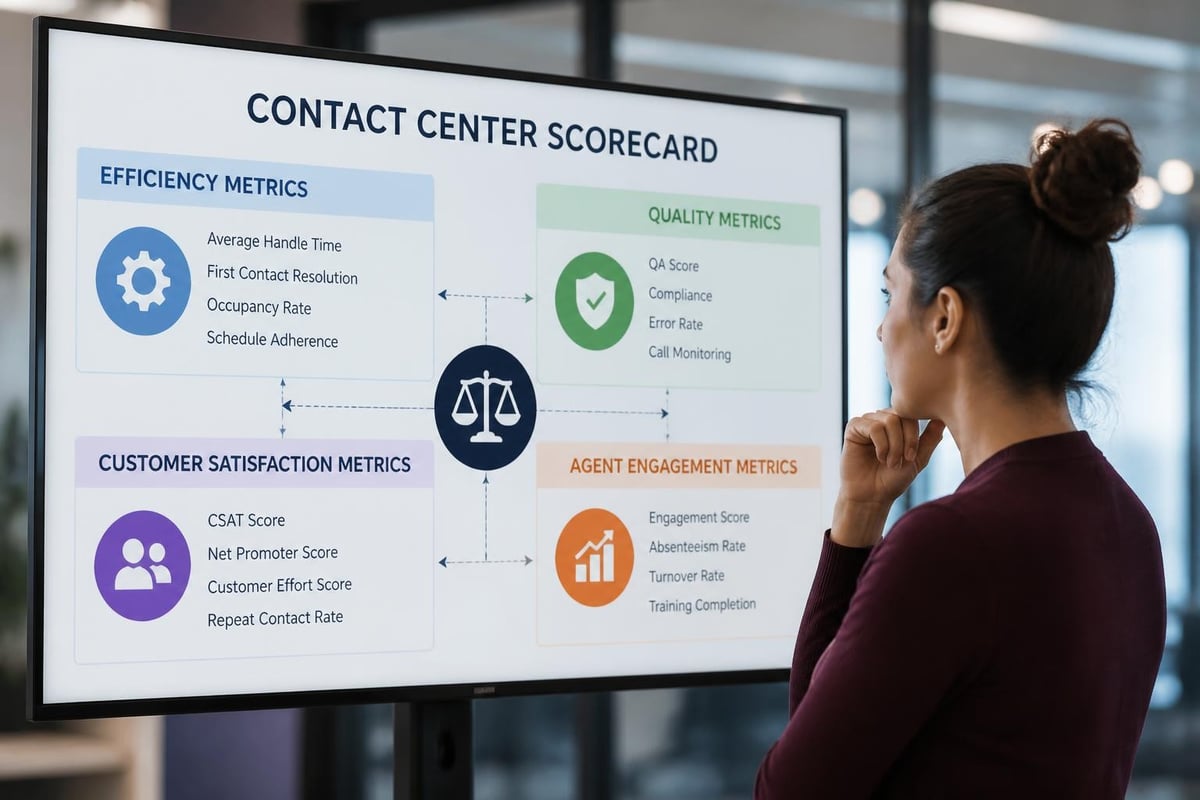
Call center best practices include systematic measurement of operational performance against both internal targets and external benchmarks. Metrics provide objective assessment of current performance while identifying improvement priorities.
Selecting the Right KPIs
Not all metrics deserve equal attention. Leading organizations focus measurement efforts on indicators that directly impact business outcomes rather than tracking every available data point.
Essential performance categories include:
- Service level and speed of answer measuring accessibility
- First contact resolution (FCR) indicating issue resolution effectiveness
- Customer satisfaction (CSAT) and Net Promoter Score (NPS) capturing experience quality
- Average handle time (AHT) balancing efficiency with thoroughness
- Agent occupancy and utilization optimizing resource deployment
- Schedule adherence ensuring planned staffing materializes
Organizations should establish clear targets for each metric, considering industry standards while accounting for unique business requirements. Balanced scorecards prevent over-optimization of individual metrics at the expense of overall performance.
Implementing Effective Benchmarking Programs
Contact center benchmarking provides external perspective on performance, revealing gaps and opportunities that internal analysis might miss. However, effective benchmarking requires careful execution to ensure meaningful comparisons.
Benchmarking best practices include:
| Benchmarking Phase | Key Considerations | Common Pitfalls to Avoid |
|---|---|---|
| Peer group selection | Similar industry, size, and complexity | Comparing dissimilar operations |
| Metric definition alignment | Consistent calculation methodologies | Definitional inconsistencies |
| Data collection | Accurate, complete submissions | Missing context or qualifiers |
| Analysis and interpretation | Understanding root causes of variance | Surface-level comparison only |
| Action planning | Prioritized improvement initiatives | Attempting too many changes simultaneously |
External benchmarking complements internal trend analysis, providing both competitive context and identification of achievable performance levels. Organizations should participate in industry benchmarking studies while establishing peer networks for informal comparison and best practice sharing.
Enhancing Customer Experience Through Process Excellence
Operational efficiency and customer satisfaction need not compete as objectives. Well-designed processes enable both rapid issue resolution and positive interaction experiences.
Streamlining Customer Journeys
Customer effort represents a primary driver of satisfaction and loyalty. Organizations that minimize the work customers must perform to resolve issues or complete transactions earn higher satisfaction scores and stronger retention.
Process optimization focuses on reducing customer effort through:
- Clear self-service options for routine transactions and information requests
- Intelligent routing to qualified agents on first contact
- Proactive information gathering before transferring between departments
- Authorization to resolve issues without multiple escalations
- Follow-up protocols ensuring complete resolution before case closure
Process mapping exercises identify friction points in current customer journeys, revealing opportunities to eliminate unnecessary steps, consolidate handoffs, and empower frontline resolution. Cross-functional collaboration ensures process improvements consider perspectives from operations, IT, and business stakeholders.
Empowering First Contact Resolution
First contact resolution directly impacts both customer satisfaction and operational costs. Resolved issues prevent repeat contacts, reducing workload while improving customer perception of competence and efficiency.
Strategies for improving FCR include:
- Comprehensive agent training covering full product and service scope
- Expanded agent authority enabling resolution without supervisor approval
- Integrated knowledge systems providing rapid access to troubleshooting guides
- Skills-based routing connecting customers with qualified agents initially
- Call-back technology eliminating forced re-explanations after disconnections
Organizations should measure FCR through post-contact surveys rather than relying solely on agent disposition codes. Customer perspective on resolution provides more accurate assessment than internal categorization.
Driving Engagement and Retention
Agent turnover disrupts operations, increases training costs, and degrades customer experience quality. Call center best practices prioritize creating work environments that attract, develop, and retain talented professionals.
Creating Positive Work Environments
Contact center work presents inherent challenges including repetitive tasks, difficult customer interactions, and performance pressure. Thoughtful workplace design and culture development mitigate these stressors while emphasizing meaningful aspects of customer service roles.
Engagement drivers include:
- Clear career pathways showing advancement opportunities within the organization
- Recognition programs celebrating individual and team achievements
- Flexible scheduling accommodating work-life balance preferences where operationally feasible
- Collaborative team culture fostering peer support and knowledge sharing
- Meaningful feedback connecting daily work to organizational mission and customer impact
Regular employee surveys provide insight into satisfaction drivers and areas requiring attention. Action planning based on survey results demonstrates organizational commitment to employee experience.
Supporting Agent Wellbeing
Contact center work can be emotionally demanding, particularly in industries like healthcare or finance where customers contact support during stressful situations. Organizations that prioritize agent wellbeing reduce burnout and turnover while maintaining service quality.
Support mechanisms include:
| Wellbeing Initiative | Implementation Approach | Expected Impact |
|---|---|---|
| Stress management training | Workshops and resources | Improved coping skills |
| Mental health resources | EAP access and counseling | Reduced burnout |
| Break optimization | Adequate time away from phones | Sustained energy levels |
| Workload balancing | Fair distribution of difficult interactions | Perceived equity |
| Manager support training | Coaching for supervisors | Stronger team relationships |
Monitoring agent stress indicators allows proactive intervention before burnout occurs. Metrics like unplanned absences, quality score declines, and voluntary attrition often signal teams or individuals needing additional support.
Managing Multichannel and Multilingual Operations
Global business requirements increasingly demand contact center support across multiple languages and channels. Successfully managing this complexity requires specialized strategies and tools.
Implementing Effective Multilingual Support
Language capabilities expand market reach while meeting customer preferences for native-language support. However, multilingual operations introduce staffing, training, and quality assurance challenges.
Best practices for multilingual contact centers include:
- Native speaker recruitment ensuring cultural context and idiomatic fluency
- Language-specific quality assurance with native-speaking evaluators
- Translated knowledge bases maintaining content parity across languages
- Skills-based routing efficiently directing contacts to language-qualified agents
- Volume forecasting by language ensuring adequate coverage for each supported language
Organizations considering nearshore call center partnerships should evaluate language capabilities alongside cultural alignment and time zone compatibility. Geographic proximity to target markets often provides superior service quality compared to distant offshore alternatives.
Coordinating Omnichannel Consistency
Channel proliferation creates risk of inconsistent messaging and disjointed customer experiences. Successful omnichannel strategies ensure seamless transitions and consistent information regardless of customer contact method.
Coordination requirements include:
- Unified knowledge management ensuring all channels access identical information
- Consistent policies applying the same resolution authority across channels
- Channel-appropriate communication adapting tone while maintaining message consistency
- Cross-channel context preservation enabling seamless channel switching
- Integrated reporting providing holistic view of customer interaction patterns
Channel-specific metrics should complement overall performance measurement, identifying optimization opportunities unique to each interaction method while maintaining focus on total customer experience quality.
Implementing call center best practices requires sustained commitment to operational excellence, technology investment, and people development. Organizations that master these fundamentals achieve measurable improvements in customer satisfaction, operational efficiency, and agent engagement. InfraWeb combines proven methodologies with advanced technology through the HELION platform, delivering call center services that transform customer interactions while optimizing costs. Our Romania-based operations provide nearshore advantages with multilingual capabilities and AI-enhanced efficiency, helping businesses exceed customer expectations while maintaining operational control.