
Understanding call center pricing requires more than comparing hourly rates or monthly retainers. Business leaders evaluating outsourced contact centre partners must navigate a complex landscape of pricing models, hidden costs, and value metrics that directly impact customer experience and operational efficiency. As organizations increasingly demand transparency and performance-driven contracts, the traditional pricing structures of the contact centre industry are evolving to reflect new technologies, automation capabilities, and customer expectations. This comprehensive examination explores the key pricing models, cost drivers, and strategic considerations that shape vendor selection and contract negotiations in 2026.
Core Call Center Pricing Models
The foundation of call center pricing rests on several established commercial structures, each with distinct advantages depending on operational needs and risk tolerance.
Per-Seat or Per-Agent Pricing
Per-seat pricing charges a fixed monthly or annual fee for each dedicated agent or workstation assigned to your account. This model provides predictable costs and guaranteed resource availability, making it ideal for businesses with stable, high-volume contact requirements.
Key characteristics include:
- Fixed monthly cost regardless of call volume fluctuations
- Dedicated agents familiar with your brand and processes
- Easier budgeting and financial forecasting
- Typically requires minimum commitment periods (6-12 months)
Organizations using inbound call center services often prefer per-seat arrangements when they need consistent coverage across predictable shifts. The challenge lies in efficiently managing capacity during seasonal peaks and valleys, which can lead to either underutilized seats or insufficient coverage.
Per-Minute or Per-Contact Pricing
Per-minute (or per-contact) pricing charges based on actual usage, whether measured in call minutes, email responses, chat sessions, or other interactions. This consumption-based model aligns costs directly with activity levels.
Advantages of usage-based pricing:
- Pay only for actual service delivered
- Lower financial risk during slow periods
- Flexibility to scale up or down quickly
- No commitment to minimum seat counts
Disadvantages to consider:
- Less predictable monthly costs
- Higher per-unit rates compared to dedicated seats
- Potential for shared agents less familiar with your brand
- Cost volatility during unexpected volume spikes
ContactBabel's annual benchmarking research shows that per-contact pricing gained market share through 2025-2026, particularly among mid-sized businesses seeking greater cost flexibility as economic uncertainty persisted.

Blended and Hybrid Pricing Structures
Many sophisticated call center pricing arrangements combine elements of multiple models to balance predictability with flexibility. A common hybrid approach includes a base fee covering minimum capacity plus usage charges above defined thresholds.
| Pricing Component | Hybrid Structure Example | Benefit |
|---|---|---|
| Base commitment | 10 dedicated seats | Guaranteed capacity and lower per-unit cost |
| Overflow pricing | Per-minute for additional volume | Flexibility during peaks without over-provisioning |
| Performance incentives | Quality bonuses/penalties | Alignment on service delivery outcomes |
| Technology fees | Platform access charges | Transparent separation of labor and technology costs |
This blended approach addresses the limitations of single-model contracts while providing both parties with manageable risk profiles. Organizations can secure core capacity at favorable rates while maintaining the agility to handle volume variability without the expense of maintaining excess dedicated seats year-round.
Cost Drivers Beyond Labor Rates
While agent labor typically represents 60-70% of contact centre operating costs, call center pricing must account for numerous additional factors that significantly impact total cost of ownership.
Technology and Infrastructure Costs
Modern contact centres require substantial technology investment that vendors recover through pricing. These components include:
- Telephony infrastructure: VoIP systems, carrier fees, number provisioning
- CRM and ticketing platforms: Licensing, customization, and integration
- Workforce management tools: Scheduling, forecasting, and quality monitoring
- Reporting and analytics: Dashboards, business intelligence, and performance tracking
- Security and compliance: Encryption, PCI DSS compliance, data protection measures
KPMG's compliance guidance highlights how PCI DSS requirements for payment card handling add measurable overhead to contact centre operations, costs that must be reflected in pricing for financial services and e-commerce clients.
Training and Quality Assurance
Effective onboarding and ongoing training programs represent significant investments that distinguish premium providers. Initial agent training typically spans 2-4 weeks for complex products or technical support roles, with continuing education required to maintain service quality.
Training cost considerations:
- Industry-specific certification requirements
- Multi-language capability development
- Product knowledge complexity
- Technology tool proficiency
- Soft skills and customer experience training
Quality assurance programs add further cost through call monitoring, feedback sessions, and continuous improvement initiatives. These investments directly correlate with first-call resolution rates and customer satisfaction scores, making them essential for value-focused partnerships.
Location and Labor Market Factors
Geographic location profoundly influences call center pricing through labor cost differentials, real estate expenses, and operational overhead variations. Nearshore locations like Romania offer compelling value propositions by combining educated, multilingual talent pools with cost structures substantially below Western European rates while maintaining cultural affinity and convenient time zone alignment.
The nearshore call center model has grown increasingly attractive as businesses balance cost optimization with service quality requirements and data residency considerations that make offshore options less viable.
Value-Based Pricing and Outcome-Driven Contracts
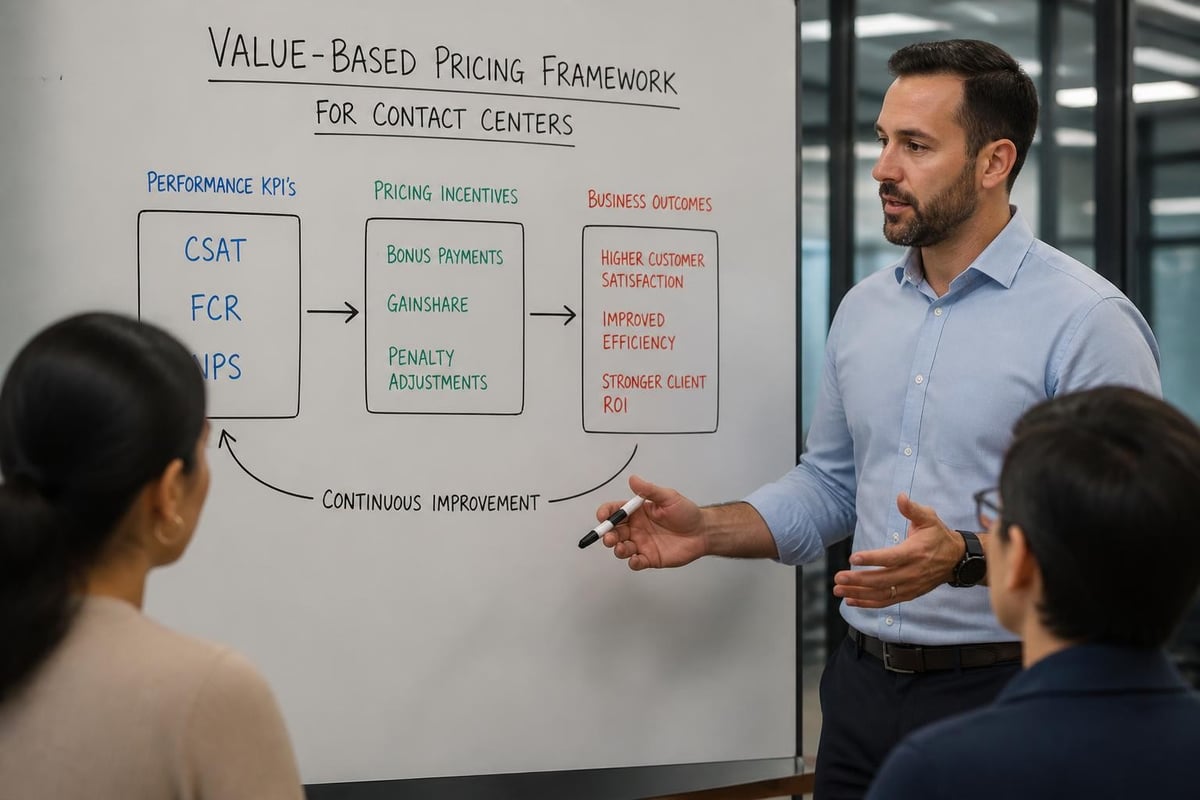
Traditional time-and-materials pricing is giving way to more sophisticated arrangements that tie compensation to business outcomes and customer experience metrics. This shift reflects growing recognition that the cheapest per-minute rate rarely delivers the best total value.
Performance-Based Pricing Components
Value-based pricing incorporates incentives and penalties tied to mutually agreed key performance indicators:
- Customer satisfaction (CSAT): Bonuses for exceeding target satisfaction scores
- First-call resolution (FCR): Financial incentives for resolving issues without transfers or callbacks
- Net Promoter Score (NPS): Compensation adjustments based on customer loyalty metrics
- Sales conversion: Revenue-sharing on outbound campaign results
- Average handle time (AHT): Efficiency bonuses for optimal (not minimum) handling times
Harvard Business Review's value-based pricing framework provides foundational principles applicable to contact centre partnerships, emphasizing the importance of quantifying customer value delivered rather than simply tallying costs incurred.
Strategic Partnership Structures
The most advanced call center pricing arrangements move beyond transactional vendor relationships toward strategic partnerships where both parties share risk and reward. These structures often include:
- Gain-sharing agreements: Splitting cost savings from efficiency improvements
- Revenue participation: Percentage of incremental sales generated
- Cost-plus with open books: Transparent cost structure plus agreed margin
- Outcome guarantees: Service level commitments with financial consequences
Organizations exploring customer service outsourcing increasingly seek partners willing to align financial terms with shared business objectives rather than simply maximizing agent utilization or call volumes.
Pricing Transparency and Hidden Costs
Effective vendor evaluation requires understanding the complete cost picture beyond headline rates. Many call center pricing proposals contain clauses or assumptions that materially impact total expenditure.
Common Hidden or Variable Costs
Setup and onboarding fees:
- Initial program design and configuration
- Agent recruitment and training
- Technology integration and testing
- Knowledge base development
Ongoing variable charges:
- Telephony carrier fees and toll-free number costs
- Premium support hours (evenings, weekends, holidays)
- Outbound dialing list management and data cleansing
- Multilingual service premiums
- Expedited reporting or custom analytics
Change order and scope expansion:
- Additional product line training
- New channel implementation (adding chat, email, social)
- Script revisions and quality monitoring updates
- Seasonal surge capacity provisions
| Cost Category | Typical Impact on Total Price | Negotiation Leverage |
|---|---|---|
| Setup fees | 5-15% of first year contract | High - often waivable for multi-year commitments |
| Technology platform | 10-20% of monthly recurring | Medium - depends on required customization |
| Premium hours | 15-30% markup over base rates | Medium - define thresholds and rates upfront |
| Multilingual support | 10-25% premium per language | Low - specialized skill premium justified |
Deloitte's contact center research emphasizes that organizations achieving the best total value focus on cost-per-interaction (CPI) and customer lifetime value impact rather than purely minimizing hourly labor rates.
Technology Impact on Pricing Models
Automation, artificial intelligence, and digital channels are fundamentally reshaping call center pricing structures and vendor capabilities. These technological advances create both opportunities for cost reduction and new pricing complexities.
AI and Automation Pricing Considerations
The integration of AI voice agents, chatbots, and intelligent routing systems introduces new cost-benefit calculations. While automation can dramatically reduce per-contact costs for routine inquiries, implementation requires upfront investment and ongoing refinement.
Automation pricing approaches:
- Hybrid human-AI models: Lower blended rates reflecting automation deflection
- Tiered pricing by complexity: Different rates for automated versus human-handled contacts
- Consumption-based AI fees: Per-interaction charges for bot conversations
- Platform licensing: Separate fees for AI technology access and customization
Providers offering help desk outsourcing increasingly incorporate tiered support models where Level 1 queries handled by AI or junior agents carry lower costs than complex Level 2-3 technical issues requiring senior expertise.
Omnichannel Pricing Complexity
As customer communication preferences diversify across voice, email, chat, SMS, social media, and messaging apps, pricing must accommodate varied handling requirements and agent skill sets.
Different channels present distinct cost profiles:
- Voice calls: Highest cost per contact, synchronous, requires dedicated agent time
- Email: Lower cost, asynchronous, allows higher agent productivity
- Live chat: Medium cost, semi-synchronous, agents can handle 2-3 concurrent chats
- Social media: Variable cost, requires specialized skills and brand sensitivity
- Self-service/IVR: Lowest cost per interaction but highest implementation cost
Sophisticated call center pricing proposals itemize rates by channel rather than averaging across all interaction types, providing greater transparency and alignment with actual resource consumption. The platform that powers these omnichannel operations, such as InfraWeb's proprietary HELION system, integrates CRM, ticketing, and communication tools to optimize routing and agent productivity across all channels.
Regional Pricing Variations and Nearshore Advantages
Geographic arbitrage remains a fundamental driver of outsourcing decisions, but the equation has evolved beyond simple labor cost comparison to encompass total value delivery.
Eastern European Nearshore Value Proposition
Romania and neighboring markets in Eastern Europe have emerged as compelling nearshore destinations for Western European companies seeking to balance cost optimization with quality, cultural alignment, and regulatory compliance.
Key advantages of Romanian contact centres:
- Labor costs 40-60% below Western European rates
- Highly educated, multilingual workforce (Romanian, English, French, German, Italian, Spanish)
- EU membership ensuring GDPR compliance and data protection alignment
- One-hour time zone difference from Western Europe enabling real-time collaboration
- Strong technical aptitude supporting complex helpdesk and technical support requirements
When evaluating call center pricing from nearshore versus offshore locations, consider these total cost of ownership factors:
- Travel and oversight expenses: Proximity reduces management travel costs and time
- Cultural compatibility: Shared European business culture improves training efficiency
- Language quality: Native or near-native language capability reduces misunderstandings
- Time zone alignment: Real-time collaboration without night-shift premiums
- Regulatory compliance: Simplified data residency and privacy law adherence
Organizations requiring call center services available 24x7 benefit from Romania's geographic position bridging Western European business hours with early coverage for APAC markets.

Contract Terms and Pricing Flexibility
Beyond the fundamental pricing model, contract structure significantly impacts both cost and operational flexibility over the partnership lifecycle.
Commitment Periods and Volume Commitments
Most call center pricing proposals include minimum commitment terms balancing vendor investment in setup, training, and dedicated resources against client flexibility needs.
Common commitment structures:
- Month-to-month: Maximum flexibility, highest per-unit rates, limited vendor investment
- 6-month terms: Moderate pricing, suitable for pilot programs or seasonal campaigns
- 1-year agreements: Standard structure balancing price and flexibility
- Multi-year contracts: Lowest rates, annual volume commitments, price lock provisions
Volume commitments often include minimum monthly interaction counts or seat utilization thresholds. Failing to meet minimums typically triggers shortfall penalties, while exceeding forecasts may invoke capacity constraints or premium pricing for surge volumes.
Scalability and Ramp Provisions
Effective contracts anticipate business growth, seasonal fluctuations, and market uncertainties through scalability provisions:
- Ramp schedules: Phased agent additions during onboarding period
- Flex capacity: Pre-negotiated overflow rates for temporary volume increases
- Downward flexibility: Minimum notice periods and penalties for reducing committed capacity
- Termination clauses: Exit conditions, wind-down periods, knowledge transfer requirements
A16z's exploration of usage-based pricing discusses how consumption models create revenue predictability challenges for vendors while providing customer flexibility, a tension that shapes contact centre contract negotiations and pricing risk allocation.
Evaluating Total Value Beyond Price
While cost remains a critical factor, the lowest call center pricing rarely delivers optimal business outcomes. A comprehensive evaluation framework considers multiple dimensions of value creation.
Total Cost of Ownership Analysis
Smart procurement teams build TCO models incorporating:
| Cost Element | Year 1 | Year 2 | Year 3 |
|---|---|---|---|
| Base service fees | Direct vendor charges | Direct vendor charges | Direct vendor charges |
| Setup and onboarding | One-time implementation | Minimal | Minimal |
| Internal management overhead | Program management FTE | Ongoing oversight | Ongoing oversight |
| Technology integration | API development, testing | Enhancements | Enhancements |
| Quality impacts | Customer churn costs | Retention improvements | Brand value impact |
Customer Experience and Brand Impact
Premium providers justify higher call center pricing through measurable customer experience improvements that drive business results:
- Reduced customer churn: Lower attrition rates increase lifetime value
- Higher conversion rates: Better-trained agents close more sales opportunities
- Improved brand perception: Quality interactions enhance reputation and referrals
- Faster issue resolution: First-call resolution reduces repeat contacts and costs
Forrester's guidance on value-based pricing recommends combining seat-based, feature-based, and consumption metrics to create pricing structures that align vendor incentives with customer success outcomes.
Vendor Selection and Negotiation Strategies
Armed with understanding of call center pricing models and cost drivers, procurement teams can approach vendor selection and contract negotiation more strategically.
RFP Development and Pricing Clarity
Request for Proposal documents should require vendors to:
- Itemize all cost components: Separate labor, technology, overhead, and margin
- Specify assumptions: Volume forecasts, hours of operation, channel mix, languages
- Provide multiple scenario pricing: Best case, expected case, worst case volumes
- Detail performance guarantees: SLAs with financial teeth, not aspirational targets
- Clarify change order processes: How scope changes and pricing adjustments work
Negotiation Leverage Points
Effective negotiation focuses on mutual value creation rather than purely cost reduction:
- Longer commitments for better rates: Exchange term certainty for pricing concessions
- Volume guarantees: Commit to minimum scale in return for capacity guarantees and lower unit costs
- Performance incentives: Share savings from efficiency improvements or quality achievements
- Payment terms: Negotiate favorable payment schedules in exchange for rate improvements
- Reference opportunities: Provide case study rights or references for pricing benefits
Organizations evaluating BPO services benefit from approaching negotiations as partnership discussions focused on aligned incentives and shared success rather than adversarial cost minimization.
Emerging Trends Shaping Future Pricing
The contact centre industry continues evolving rapidly, with several trends likely to reshape call center pricing structures through 2026 and beyond.
Increased AI-Human Collaboration Pricing
As AI capabilities mature, expect more sophisticated pricing reflecting the blend of automated and human touchpoints. Vendors will offer:
- Tiered pricing based on AI deflection rates achieved
- Risk-sharing models where both parties benefit from automation improvements
- Consumption charges only for human-escalated interactions
- Platform fees for AI agent technology plus service fees for human backup
Outcome and Revenue-Based Models
Moving beyond cost-plus and time-and-materials, progressive vendors embrace pricing tied directly to business results:
- Commission structures for sales-focused campaigns
- Customer lifetime value-linked fees for retention programs
- Cost-per-acquisition models for lead generation
- Subscription-style pricing with quality guarantees
Contact Center Pipeline's industry analysis indicates that outcome-based pricing arrangements grew 30% year-over-year in 2025 as both buyers and vendors gained sophistication in measuring and attributing business impact.
Dynamic and Real-Time Pricing
Technology enables more granular, dynamic pricing approaches:
- Real-time capacity markets matching supply and demand
- Surge pricing for immediate-need overflow capacity
- Off-peak discounts encouraging volume during typically slow periods
- Channel-specific pricing reflecting actual handling costs
These innovations promise greater efficiency and fairness but require sophisticated systems and trust between partners to implement effectively.
Understanding the nuances of call center pricing empowers organizations to make informed outsourcing decisions that balance cost efficiency with service quality and business outcomes. By evaluating total value rather than simply comparing hourly rates, and by structuring contracts that align vendor incentives with customer experience goals, businesses can build partnerships that drive sustainable competitive advantage. InfraWeb delivers transparent, value-focused contact centre solutions from Romania, combining competitive nearshore pricing with advanced technology and performance-driven service models. Explore how our HELION platform and experienced teams can optimize your customer engagement strategy while managing costs effectively.