
Creating a nice contact center goes far beyond installing phone systems and hiring agents. Today's customers expect seamless, personalized interactions across every channel, while businesses demand efficiency and measurable results. A truly nice contact center balances cutting-edge technology with human expertise, operational excellence with employee satisfaction, and cost management with service quality. Whether you're building a new operation or transforming an existing one, understanding the fundamental elements that define modern contact center excellence will help you deliver experiences that keep customers loyal and agents engaged.
What Defines a Nice Contact Center in 2026
A nice contact center stands apart through its commitment to both customer satisfaction and agent wellbeing. The foundation rests on three interconnected pillars that work in harmony.
Technology infrastructure powers everything from routing algorithms to AI-driven insights. Modern platforms integrate voice, chat, email, social media, and messaging into unified agent desktops. These systems provide context across every interaction, eliminating the frustration of customers repeating information. Nearshore solutions often combine advanced technology with cost-effective delivery models, making enterprise-grade capabilities accessible to growing businesses.
Agent experience directly impacts customer experience. A nice contact center invests in comprehensive training, career development pathways, and tools that reduce repetitive work. When agents feel supported and empowered, they deliver better service. This includes:
- Intuitive interfaces that minimize clicks and screen switching
- Real-time coaching and knowledge base access
- Flexible scheduling options that respect work-life balance
- Recognition programs that celebrate excellence
- Clear escalation paths for complex issues
Customer-centric culture permeates every decision. Metrics shift from pure speed to quality outcomes. Leadership prioritizes long-term relationships over transaction volume. Policies empower agents to resolve issues without excessive approvals.

The Role of Omnichannel Communication
Customers initiate conversations on their preferred channels and expect continuity when switching between them. A nice contact center maintains complete context whether someone starts on webchat, continues via email, and concludes with a phone call.
Implementation requires careful planning across technical and operational dimensions. Channel-specific skills matter less than holistic customer understanding. Agents need visibility into the complete interaction history, regardless of where previous touchpoints occurred.
| Channel | Response Expectation | Best Use Case | Integration Priority |
|---|---|---|---|
| Phone | Immediate | Complex issues, urgent matters | High - core capability |
| 24 hours | Detailed inquiries, documentation | High - established standard | |
| Live Chat | Under 2 minutes | Quick questions, browsing support | High - real-time expectation |
| Social Media | 1-4 hours | Public feedback, brand engagement | Medium - reputation impact |
| SMS/Messaging | Varies by context | Appointment reminders, updates | Medium - growing preference |
Successful omnichannel customer service depends on data architecture that connects disparate systems. Customer profiles aggregate interaction history, purchase records, support tickets, and preference settings into actionable intelligence. Agents see this unified view instantly, transforming generic scripts into personalized conversations.
Building Your Technology Stack for Excellence
The technology choices you make today will shape operations for years. A nice contact center evaluates platforms through the lens of scalability, integration capability, and user experience.
Core Platform Requirements
Your contact center platform serves as the operational backbone. Essential capabilities include:
Intelligent routing that considers agent skills, customer value, interaction history, and current workload. Advanced systems use predictive analytics to match customers with the best-suited agents, improving first-call resolution rates and satisfaction scores.
Workforce management tools that forecast volume accurately and schedule efficiently. According to best practices for modern workforce management, organizations that excel at forecasting and scheduling achieve 10-15% higher agent utilization while maintaining better service levels.
Quality monitoring capabilities that sample interactions, score performance, and identify coaching opportunities. Modern systems apply AI to analyze 100% of interactions rather than small random samples, surfacing patterns that human reviewers might miss.
Analytics and reporting that deliver real-time dashboards and historical trend analysis. Leaders need visibility into key metrics like average handle time, customer satisfaction scores, and resolution rates across dimensions like agent, team, channel, and issue type.
The HELION platform exemplifies integrated architecture by combining these elements with AI voice agents, CRM functionality, and ticketing systems in a unified environment designed specifically for multilingual contact center operations.
AI Integration Strategies
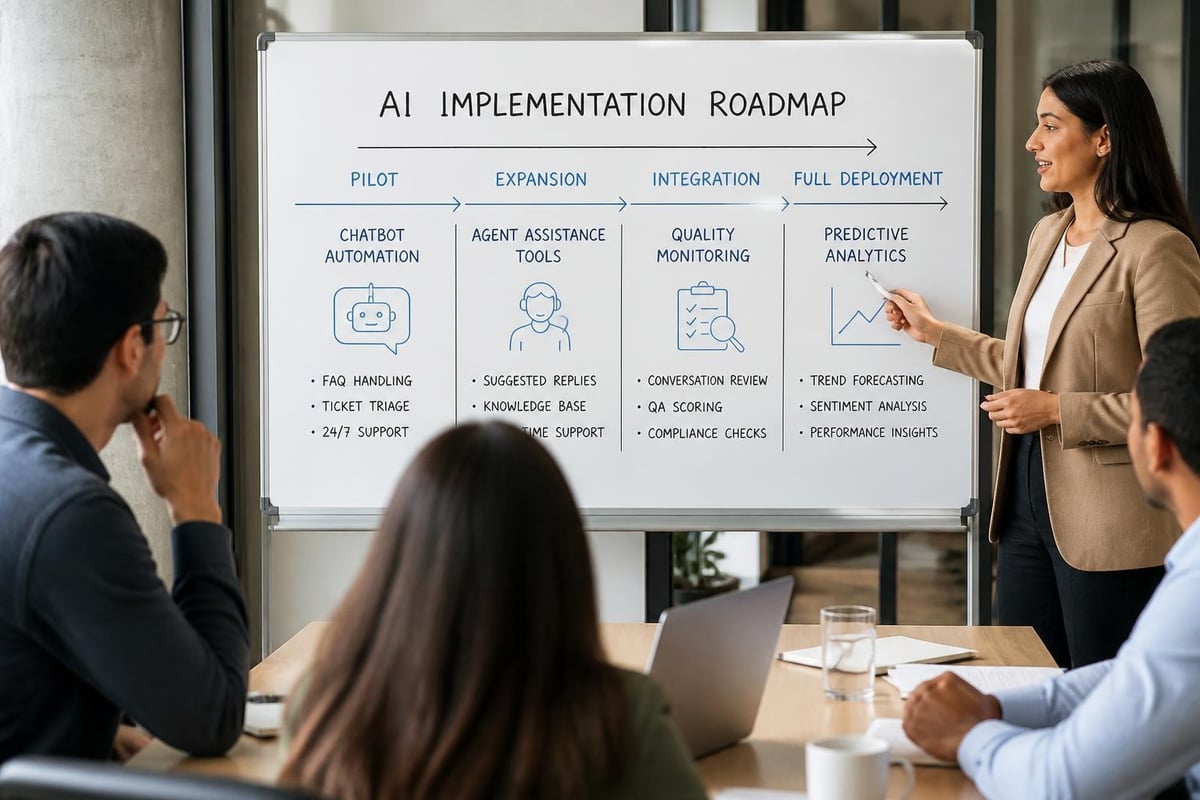
Artificial intelligence transforms contact center capabilities when implemented thoughtfully. Generative AI is reshaping contact centers through applications ranging from automated responses to predictive analytics.
A nice contact center adopts AI systematically rather than chasing every new trend. Start with high-value, low-risk applications:
- Intelligent virtual assistants that handle routine inquiries, allowing agents to focus on complex situations requiring empathy and judgment
- Real-time agent guidance that suggests responses, surfaces relevant knowledge articles, and flags compliance risks during live interactions
- Sentiment analysis that detects customer frustration early, enabling proactive intervention before issues escalate
- Automated quality assurance that evaluates every interaction against defined criteria, ensuring consistency and identifying training needs
Systematic AI adoption requires governance frameworks that address data privacy, model accuracy, and human oversight. Organizations succeed when they pilot small, measure rigorously, and scale proven applications while maintaining transparency about AI involvement in customer interactions.
Operational Excellence Through People and Process
Technology enables great service, but people deliver it. A nice contact center recognizes that agent satisfaction and customer satisfaction move in tandem.
Recruitment and Training Strategies
Hiring for attitude and training for skill remains valid wisdom. Look for candidates who demonstrate:
- Natural empathy and patience
- Problem-solving orientation
- Communication clarity
- Resilience under pressure
- Alignment with company values
Training programs should extend far beyond product knowledge and system navigation. Comprehensive onboarding includes:
Soft skills development covering active listening, de-escalation techniques, and emotional intelligence. Role-playing exercises prepare agents for difficult conversations before they face real customers.
Scenario-based learning that presents realistic situations with branching outcomes. This approach builds decision-making confidence more effectively than memorizing scripts.
Continuous education that keeps pace with product updates, policy changes, and emerging customer needs. Microlearning modules delivered in short bursts fit naturally into agent workflows without overwhelming schedules.
Certification pathways that recognize expertise and create advancement opportunities. Agents who see career progression stay engaged and contribute institutional knowledge.
Performance Management and Coaching
Traditional metrics like average handle time and calls per hour tell incomplete stories. A nice contact center balances efficiency with effectiveness by measuring what truly matters:
- Customer satisfaction scores gathered through post-interaction surveys
- First-contact resolution rates indicating how often customers get complete solutions without callbacks
- Net Promoter Score capturing likelihood to recommend based on service experience
- Quality assurance scores reflecting adherence to standards and best practices
- Agent satisfaction tracked through engagement surveys and retention rates
Regular coaching conversations use data to guide development rather than punish shortcomings. Strong coaches celebrate strengths, identify improvement opportunities, and co-create action plans. They listen to agents' frontline insights, which often reveal process inefficiencies or customer pain points that leadership overlooks.
Security and Compliance as Competitive Advantages
Customer trust depends on protecting sensitive information. A nice contact center treats security and compliance as foundational rather than burdensome requirements.
Data Protection Frameworks
Contact centers handle personally identifiable information, payment details, health records, and confidential business data. Robust protection requires layered controls:
Access management limits data visibility to those with legitimate business needs. Role-based permissions ensure agents see only information necessary for their functions.
Encryption protocols protect data in transit and at rest. Secure communication channels prevent interception, while encrypted storage safeguards information from unauthorized access.
Audit trails record who accessed what data when, creating accountability and enabling investigation if breaches occur.
For operations handling payment card information, PCI DSS compliance establishes mandatory security standards that protect cardholder data throughout processing, storage, and transmission.
Industry-Specific Requirements
Different sectors impose unique compliance obligations. Healthcare contact centers must adhere to privacy regulations protecting patient information. Financial services operations face strict record-keeping and disclosure requirements. Understanding these nuances separates compliant operations from those courting regulatory trouble.
A nice contact center builds compliance into operational design rather than treating it as an afterthought. Regular training ensures agents understand their responsibilities. Monitoring systems flag potential violations before they become problems. Documentation proves due diligence to auditors and regulators.
| Compliance Area | Key Requirements | Implementation Approach |
|---|---|---|
| Data Privacy | Consent management, right to deletion, breach notification | Privacy-by-design architecture, documented procedures |
| Payment Security | PCI DSS validation, secure card handling, quarterly scans | Tokenization, agent training, regular audits |
| Recording Disclosure | Notification before recording, secure storage, retention limits | Automated announcements, encrypted archives |
| Accessibility | Service availability for disabled customers, accommodation | TTY support, trained specialists, assistive technologies |

Measuring and Improving Customer Experience
A nice contact center commits to continuous improvement driven by customer feedback and operational data. Measurement creates accountability and reveals optimization opportunities.
Essential Metrics and KPIs
Effective measurement balances operational efficiency with experience quality. Track metrics across multiple categories:
Volume and Efficiency:
- Total contacts by channel and time period
- Average handle time and after-call work
- Service level achievement (percentage answered within target time)
- Abandonment rate for queued interactions
Quality and Satisfaction:
- Customer satisfaction score (CSAT)
- Net Promoter Score (NPS)
- Customer effort score (CES)
- First-contact resolution rate
- Quality assurance scores
Agent Performance:
- Adherence to schedule
- Average speed of answer
- Occupancy rate
- Utilization rate
- Individual quality scores
Deloitte's research on contact center transformation reveals that leading organizations integrate analytics across these dimensions, identifying correlations between agent satisfaction, process efficiency, and customer outcomes.
Voice of Customer Programs
Direct customer feedback provides insights that metrics alone cannot capture. Structured programs gather input through:
Post-interaction surveys triggered immediately after service delivery when experiences remain fresh. Keep surveys brief, focusing on satisfaction, resolution, and effort required.
Relationship surveys sent periodically to assess overall perception beyond individual interactions. These broader assessments capture cumulative experience and brand loyalty.
Customer advisory boards bringing together representative customers for in-depth discussions about service delivery, pain points, and improvement priorities. These qualitative insights often inspire innovations that quantitative data never suggests.
Journey mapping exercises that trace complete customer experiences across touchpoints, revealing friction points and moments of delight. Cross-functional teams use these maps to align improvements across departments.
The Customer Experience Professionals Association provides frameworks and best practices for designing comprehensive voice of customer programs that drive meaningful organizational change.
Creating Sustainable Agent Engagement
Agent turnover destroys operational efficiency and service quality. A nice contact center prioritizes retention through intentional culture-building and career development.
Workplace Environment and Culture
Contact center work carries inherent stress. Thoughtful leaders mitigate burnout through:
Autonomy and empowerment that trusts agents to make decisions within defined parameters. Eliminating unnecessary approvals speeds resolution and demonstrates respect for agent judgment.
Team building activities that foster camaraderie and mutual support. Strong peer relationships help agents weather difficult days and celebrate successes together.
Wellness programs addressing mental health, physical fitness, and work-life integration. Access to counseling services, flexible scheduling, and adequate break time shows genuine care for agent wellbeing.
Recognition systems that celebrate both individual achievement and team success. Public acknowledgment of exceptional service reinforces desired behaviors and builds positive culture.
Career Development Opportunities
Agents need visible paths forward. A nice contact center creates progression opportunities including:
- Subject matter expert roles for agents who develop deep product knowledge and enjoy mentoring peers
- Quality assurance positions for those with strong attention to detail and coaching skills
- Workforce management analyst roles for analytically minded agents interested in forecasting and planning
- Team lead and supervisor positions for natural leaders ready for people management responsibilities
- Training specialist opportunities for agents who excel at teaching and developing others
Cross-training across channels and functions broadens skills while reducing monotony. When businesses offer comprehensive call center services available 24x7, agents benefit from shift variety and exposure to different customer segments.
Leveraging Outsourcing and Partnership Models
Not every organization should operate contact centers in-house. Strategic outsourcing delivers expertise, scalability, and cost efficiency when aligned with business objectives.
When to Consider Outsourcing
Outsourcing makes strategic sense when:
Volume fluctuates significantly across seasons, campaigns, or business cycles. Outsourced partners absorb demand variation without permanent staffing overhead.
Specialized expertise is required for technical support, multilingual service, or industry-specific knowledge. Building this expertise internally demands substantial investment and time.
Focus needs to remain on core competencies rather than contact center operations. Companies excel by concentrating resources on product development, sales, or other differentiating activities.
Speed to market matters for new product launches or geographic expansion. Established partners provide immediate capacity and proven processes.
Cost optimization is essential without sacrificing quality. Nearshore models combine cultural alignment and time zone compatibility with favorable economics.
Selecting the Right Partner
Evaluate potential partners across multiple dimensions:
| Evaluation Criteria | Questions to Ask | Red Flags |
|---|---|---|
| Technology | What platforms do you use? How do integrations work? | Proprietary systems with no APIs, outdated infrastructure |
| Security | What certifications do you hold? How do you protect data? | Vague answers, no third-party audits |
| Scalability | How quickly can you add capacity? What are constraints? | Long lead times, rigid contracts |
| Performance | What metrics do you guarantee? How do you report? | No SLAs, limited transparency |
| Cultural Fit | What training do agents receive? How do you maintain quality? | High turnover, scripted responses only |
A nice contact center partnership operates as extension of your team rather than distant vendor. Regular communication, collaborative problem-solving, and aligned incentives characterize successful relationships.
Operations like InfraWeb's contact centers demonstrate how outsourced providers leverage proprietary technology and regional advantages to deliver enterprise-quality service with responsive partnership models.
Building a nice contact center requires balancing technology investment with human development, operational efficiency with service quality, and cost management with customer satisfaction. The organizations that excel recognize contact centers as strategic assets that shape brand perception and drive customer loyalty rather than cost centers to minimize. Whether you're enhancing existing operations or launching new capabilities, InfraWeb combines advanced platform technology, AI-powered automation, and experienced multilingual teams to help you deliver exceptional customer experiences that strengthen relationships and support business growth.