
Large organizations face mounting pressure to deliver exceptional customer experiences while managing costs and operational complexity. Enterprise contact center solutions have evolved far beyond simple phone systems, now encompassing sophisticated cloud platforms, artificial intelligence, omnichannel communication, and advanced analytics. These comprehensive systems enable businesses to handle thousands of daily interactions across voice, chat, email, and social channels while maintaining consistent service quality. Choosing the right enterprise contact center solutions requires understanding both current capabilities and future scalability, particularly as AI voice agents and automation reshape customer service delivery across industries.
The Architecture of Modern Enterprise Contact Center Solutions
Enterprise contact center solutions in 2026 rely on cloud-native architectures that deliver flexibility impossible with legacy on-premises systems. These platforms provide automatic scaling during peak demand periods, geographic redundancy, and continuous updates without service interruptions.
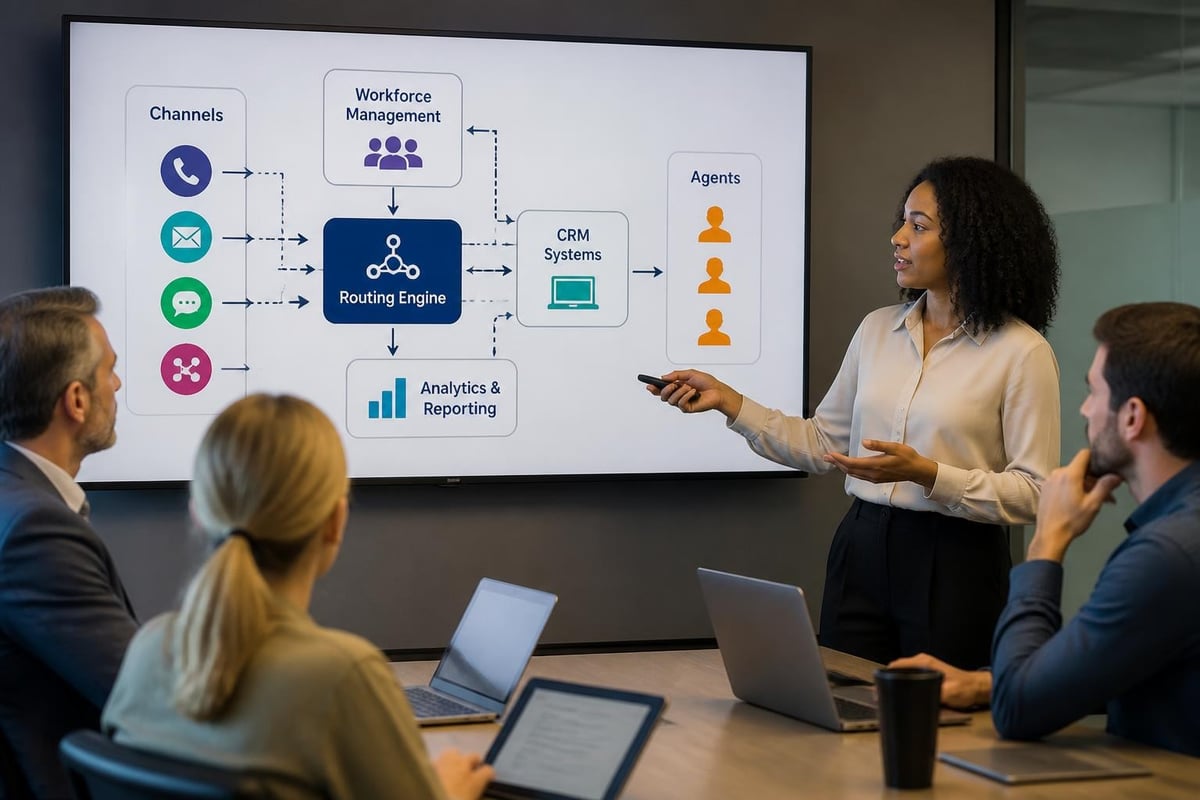
The core infrastructure typically includes several integrated layers. The communication layer handles voice, video, chat, email, SMS, and social media interactions through a unified interface. The routing and orchestration layer applies AI-powered algorithms to direct interactions to the most qualified agents based on skills, availability, historical performance, and customer context.
Platform Integration Capabilities
Modern enterprise solutions must connect seamlessly with existing business systems to provide agents with complete customer context. CRM integration pulls account history, purchase data, and previous interaction records into a single view. Ticketing systems track issue resolution across multiple touchpoints, while workforce management tools forecast staffing needs and optimize schedules.
Forrester's Q2 2025 Wave report evaluating CCaaS platforms provides comprehensive analysis of vendor capabilities across these integration dimensions, helping enterprises assess which platforms align with their technical ecosystems.
Organizations operating in regulated industries require particularly robust integration with compliance and recording systems. Financial services and healthcare enterprises need platforms that maintain audit trails, encrypt sensitive data, and support retention policies mandated by regulations.
Evaluating Vendor Capabilities and Market Positioning
The enterprise contact center solutions market includes established telecommunications providers, pure-play cloud vendors, and unified communications specialists. Each vendor category brings distinct strengths and limitations that impact long-term success.
Vendor Assessment Framework
Organizations should evaluate potential vendors across multiple dimensions simultaneously. The technical capability matrix examines AI sophistication, integration flexibility, reliability commitments, and innovation velocity. Operational considerations include implementation complexity, training requirements, ongoing support quality, and change management demands.
Financial analysis extends beyond simple subscription costs to include professional services, customization expenses, integration fees, and total cost of ownership over a three to five year period. DMG Consulting's 2025–2026 CCaaS product and market report offers detailed functional comparisons and cost benchmarks across leading platforms.
| Evaluation Category | Key Metrics | Weight in Decision |
|---|---|---|
| Technical Capabilities | AI maturity, API flexibility, uptime SLA | 30% |
| Integration Ecosystem | Pre-built connectors, middleware support | 25% |
| Total Cost of Ownership | Licensing, services, customization | 20% |
| Vendor Stability | Market position, financial health, roadmap | 15% |
| Support Quality | Response times, resolution rates, documentation | 10% |
The vendor selection process should include extensive proof-of-concept testing with realistic call volumes and complexity. Enterprises benefit from evaluating how platforms handle edge cases, fail gracefully during outages, and recover from unexpected scenarios that stress-test architectural resilience.
AI Integration and Intelligent Automation
Artificial intelligence fundamentally transforms how enterprise contact center solutions handle customer interactions. Contemporary platforms deploy AI across multiple functions, from initial contact routing to real-time agent assistance and post-interaction analysis.
Conversational AI handles routine inquiries completely autonomously, freeing human agents for complex problem-solving. These systems now support natural language understanding in dozens of languages with context awareness that enables multi-turn dialogues. For organizations serving specific markets, AI voice agents capable of conversing in Romanian or other regional languages deliver culturally appropriate service while maintaining automation efficiency.
Real-Time Agent Augmentation
The most impactful AI applications assist agents during live conversations rather than replacing them entirely. Real-time transcription provides supervisors with conversation visibility without call monitoring. Sentiment analysis detects customer frustration and automatically escalates interactions or alerts supervisors when intervention might prevent negative outcomes.
Knowledge management systems powered by large language models surface relevant articles, troubleshooting steps, and policy guidance based on conversation context. Forrester insight on harnessing tacit agent knowledge to power AI-led contact centers explores how enterprises capture institutional knowledge and make it accessible through AI-driven recommendation engines.
Predictive analytics anticipate customer needs before they're articulated. If a customer calls about a billing question, AI systems can identify related open support tickets, upcoming subscription renewals, or product recommendations based on purchase patterns across similar customer segments.
- Voice biometrics authenticate callers without lengthy security questions
- Next-best-action recommendations guide agents toward optimal resolution paths
- Automated summarization generates interaction records without manual data entry
- Compliance monitoring flags regulatory violations in real-time
Omnichannel Strategy and Execution
Enterprise contact center solutions must orchestrate consistent experiences across voice, digital, and self-service channels. True omnichannel capabilities enable customers to switch between channels mid-interaction without repeating information or losing conversation context.
Channel integration presents technical and operational challenges that extend beyond basic connectivity. Each channel carries distinct customer expectations around response time, communication style, and available service options. Voice interactions demand immediate attention, while email permits considered responses over hours rather than minutes.
Unified Customer Journey Management
The most sophisticated platforms maintain persistent conversation threads that span multiple channels and time periods. A customer might initiate contact through a chatbot, escalate to email when the automated system reaches its capability limits, and ultimately connect with an agent by phone for final resolution.
Contact centers must staff appropriately across channels while maintaining service level commitments. Workforce management becomes exponentially more complex when balancing agents skilled in voice, chat, email, and social media support. Some organizations deploy call center services available 24x7 to maintain consistent coverage across time zones and interaction types without the overhead of maintaining separate channel-specific teams.
Digital channels generate valuable behavioral data that enhances voice interactions. When customers navigate self-service portals or knowledge bases before calling, enterprise contact center solutions surface those activities to agents, providing context about what solutions the customer already attempted unsuccessfully.

Security, Compliance, and Data Protection
Enterprise environments demand rigorous security controls that protect customer data, ensure regulatory compliance, and maintain system integrity against evolving threats. Contact center platforms process sensitive personal information, payment data, and confidential business details that require multiple layers of protection.
Comprehensive Security Architecture
Network security begins with encryption for all data in transit and at rest. Modern enterprise contact center solutions implement zero-trust architectures that verify every access request regardless of network location. Multi-factor authentication protects agent workstations, administrative interfaces, and API connections from unauthorized access.
Recording and quality management systems must balance operational needs against privacy requirements. PCI compliance demands pause-resume recording functionality that stops capturing audio during credit card number recitation. GDPR and similar regulations require data minimization, purpose limitation, and the technical ability to delete customer records upon request.
TechTarget guidance on contact-center security best practices outlines practical controls for protecting customer data and telephony platforms in hybrid and remote agent environments increasingly common across enterprise operations.
Organizations operating across multiple jurisdictions face complex data residency requirements. European customers' interaction records may require storage within EU data centers, while other regions impose similar localization mandates. Enterprise platforms must support geographic data sovereignty without fragmenting the customer experience or creating operational silos.
- Conduct annual penetration testing against contact center infrastructure
- Implement privileged access management for administrative functions
- Maintain separate development, staging, and production environments
- Deploy intrusion detection systems monitoring telephony networks
- Establish incident response procedures for data breach scenarios
- Document data flows for regulatory compliance validation
Workforce Management and Agent Experience
Enterprise contact center solutions succeed or fail based on agent productivity, satisfaction, and retention. The best platforms enhance rather than burden the agent experience through thoughtful design and intelligent automation that reduces repetitive tasks.
Desktop optimization consolidates multiple applications into unified interfaces that minimize screen switching and cognitive load. Agents access customer data, knowledge bases, ticketing systems, and communication tools through single dashboards that present information contextually based on interaction type and customer segment.
Performance Management and Development
Modern workforce management extends beyond simple schedule adherence to encompass skills development, career progression, and performance optimization. AI-driven coaching identifies improvement opportunities by analyzing interaction patterns, customer feedback, and outcome metrics across thousands of conversations.
Gamification mechanics motivate agents through transparent performance visibility, peer comparisons, and recognition programs tied to quality metrics rather than pure speed. Enterprise organizations recognize that first-call resolution and customer satisfaction matter more than average handle time, designing incentive structures that reward thorough problem-solving over rapid call closure.
Quality assurance evolves from random call sampling to comprehensive automated evaluation. Speech analytics evaluate every interaction for compliance adherence, soft skills demonstration, and process compliance. Human quality analysts focus on coaching conversations and edge case review rather than routine transaction scoring.
Remote and hybrid work models require enterprise contact center solutions that support distributed teams without compromising security or collaboration. Cloud platforms enable work-from-anywhere flexibility while maintaining consistent performance monitoring and real-time supervisor visibility across geographic dispersion.
Implementation Planning and Change Management
Deploying enterprise contact center solutions requires careful planning that addresses technical migration, business process redesign, and organizational change management simultaneously. Failed implementations typically underestimate the human elements while overconfident in technical capabilities.
Phased Migration Strategies
Large enterprises rarely achieve successful "big bang" cutover migrations. Phased approaches reduce risk by validating platform capabilities with limited user groups before broader deployment. Pilot programs might begin with a single business unit, geographic region, or interaction type before expanding scope.
Migration planning must account for integration complexity with surrounding systems. Nearshore call center operations in locations like Romania provide testing environments for platform capabilities before global rollout, reducing risk to primary customer-facing operations during transition periods.
| Implementation Phase | Duration | Key Activities | Success Criteria |
|---|---|---|---|
| Discovery & Planning | 6-8 weeks | Requirements gathering, vendor selection | Signed contract, project charter |
| Platform Configuration | 8-12 weeks | Integration development, workflow design | Test environment validated |
| Pilot Deployment | 4-6 weeks | Limited user training, monitored rollout | SLA achievement, user acceptance |
| Full Production | 12-16 weeks | Complete migration, optimization | All users migrated, metrics stable |
Change management addresses the natural resistance that accompanies new systems and revised workflows. Effective communication explains not just what changes but why the new platform benefits agents through reduced manual work, better tools, and improved customer outcomes that make jobs more satisfying.
Analytics, Reporting, and Continuous Improvement
Enterprise contact center solutions generate massive data volumes that enable sophisticated analysis when properly instrumented and interpreted. Organizations that treat analytics as an afterthought miss opportunities to optimize operations, predict trends, and identify emerging customer needs before they become widespread issues.
Operational dashboards provide real-time visibility into queue depths, service levels, agent occupancy, and channel distribution. Supervisors monitor these metrics continuously to make tactical staffing adjustments and maintain service commitments during unexpected demand spikes.
Strategic Performance Analysis
Beyond real-time monitoring, enterprise platforms support historical analysis that reveals patterns, trends, and improvement opportunities invisible in daily operations. Customer effort scores, first-contact resolution rates, and net promoter scores connect contact center performance to broader business outcomes.
Advanced analytics identify root causes behind repeat contacts, long handle times, and low satisfaction scores. Text and speech analytics extract themes from thousands of conversations, highlighting product defects, confusing policies, or website navigation problems that drive unnecessary support volume.
Omdia's CCaaS Annual Tracker and Forecast provides market-level data that helps enterprises benchmark their performance against industry peers and justify continued platform investment through demonstrated ROI.
Predictive analytics forecast future demand based on historical patterns, upcoming marketing campaigns, product launches, and external events. Enterprises use these predictions to optimize staffing levels weeks in advance, reducing both understaffing scenarios that degrade service and overstaffing that inflates labor costs.

Total Cost of Ownership Considerations
Enterprise contact center solutions represent significant ongoing investments that extend well beyond subscription fees. Comprehensive TCO analysis captures licensing costs, professional services, integration expenses, training programs, ongoing support, and internal resource allocation required for platform administration.
Direct and Indirect Cost Components
Licensing models vary widely across vendors. Per-user per-month pricing provides predictable costs but may inflate expenses during seasonal peaks when temporary staff requires platform access. Consumption-based models align costs with actual usage but complicate budgeting and financial forecasting.
Professional services for implementation typically equal or exceed first-year licensing costs for complex deployments. Organizations must budget for business process consulting, custom integration development, data migration services, and specialized configuration that exceeds vendor-provided templates.
- Platform licensing and subscription fees
- Professional services for implementation and customization
- Integration development with CRM, ERP, and business systems
- Training programs for agents, supervisors, and administrators
- Ongoing vendor support contracts beyond standard SLAs
- Internal IT resources for platform administration and maintenance
- Telephony costs including PSTN connectivity and phone numbers
- Storage fees for interaction recordings and historical data
Hidden costs frequently emerge during implementation. Legacy data migration proves more complex than anticipated. Custom reporting requirements demand additional development. Integration with niche business systems requires middleware solutions not included in base platform pricing.
Organizations should model TCO across three to five year periods to capture true platform costs including future scale. Growing from 500 to 1,000 agents may trigger pricing tier changes that dramatically increase per-user costs. Customer service outsourcing arrangements sometimes provide more predictable economics than internal operations when factoring comprehensive platform and operational costs.
Geographic Distribution and Disaster Recovery
Enterprise contact center solutions must maintain service continuity during natural disasters, infrastructure failures, and other disruptions that could interrupt customer service. Geographic distribution across multiple data centers and regions provides resilience impossible with single-location deployments.
Active-active architectures distribute production workload across multiple sites simultaneously rather than maintaining idle disaster recovery capacity. These configurations deliver both resilience and performance benefits by reducing latency for customers in different geographic regions.
Business Continuity Planning
Comprehensive business continuity plans address multiple failure scenarios from individual component failures through complete site outages. Agent desktop applications should function during brief network interruptions through local caching and intelligent reconnection. Telephony platforms require redundant carrier connections that automatically fail over when primary circuits experience degradation or complete failure.
Remote agent capabilities inherently improve resilience by distributing the workforce across hundreds or thousands of locations rather than concentrating staff in centralized facilities vulnerable to regional events. Cloud platforms enable rapid activation of backup agent pools when primary teams face disruptions from weather, transportation problems, or facility issues.
Testing disaster recovery procedures validates theoretical plans before actual emergencies. Regular failover drills ensure routing configurations work correctly, agents can access systems from alternate locations, and supervisors maintain visibility across distributed operations during crisis scenarios.
Organizations serving regulated industries face specific recovery time objectives and recovery point objectives mandated by compliance frameworks. Financial services may require sub-minute failover capabilities with zero data loss, demanding premium platform capabilities and architecture sophistication beyond typical commercial requirements.
Industry-Specific Requirements and Customization
Different industries impose unique requirements on enterprise contact center solutions based on regulatory environments, business processes, and customer expectations. Healthcare organizations navigate HIPAA privacy rules, financial services operate under stringent recording requirements, and utilities manage emergency response protocols.
Vertical Solution Capabilities
Purpose-built capabilities for specific industries reduce customization costs and accelerate implementation timelines. Healthcare platforms integrate with electronic health records, support appointment scheduling workflows, and provide HIPAA-compliant communication channels. Finance solutions offer payment processing integration, fraud detection, and comprehensive audit trails.
Platforms designed for eCommerce environments integrate with order management systems, enable agents to modify shopping carts, and process returns without leaving the contact center interface. Utilities leverage geographic information systems for outage management and field service dispatch coordination.
Generic platforms require extensive customization to match industry-specific workflows. While flexibility enables precise fit to unique requirements, customization introduces ongoing maintenance costs, upgrade complexity, and vendor relationship dynamics that favor organizations with substantial technical resources.
- Document industry-specific compliance requirements during vendor evaluation
- Prioritize platforms with existing customers in your vertical
- Review pre-built integrations with industry-standard business systems
- Validate vertical expertise among vendor implementation teams
- Assess upgrade impact on custom configurations
- Consider industry-focused managed service providers
Enterprise contact center solutions have become mission-critical infrastructure that directly impacts customer satisfaction, operational efficiency, and competitive differentiation across industries. The platform selection and implementation decisions organizations make in 2026 will shape customer service capabilities for years to come, requiring careful evaluation of technical capabilities, vendor stability, total cost of ownership, and alignment with strategic business objectives. InfraWeb delivers enterprise-grade contact center services through state-of-the-art facilities in Romania, combining the HELION platform's AI capabilities with experienced multilingual teams to provide scalable, secure customer service solutions across inbound, outbound, and technical support functions.