
Call center duty encompasses far more than answering phones and logging tickets. Whether managing inbound customer inquiries, executing outbound sales campaigns, or coordinating technical support teams, the responsibilities inherent to contact center roles have evolved dramatically over the past decade. Modern agents and supervisors navigate sophisticated platforms, balance multiple communication channels, and increasingly collaborate with AI-powered tools to deliver exceptional customer experiences. Understanding the full scope of call center duty helps organizations optimize staffing, reduce attrition, and improve service quality across every customer touchpoint.
Core Responsibilities in Call Center Duty
The foundation of call center duty revolves around consistent, quality customer interaction. Agents spend the majority of their shifts engaged in direct communication, whether through voice, email, chat, or social media channels. Each interaction demands active listening, problem diagnosis, and solution delivery within strict time parameters.
Inbound Support Functions
Agents handling inbound call center duty manage a continuous stream of customer-initiated contacts. These responsibilities include:
- Responding to product questions and service inquiries
- Troubleshooting technical issues through guided diagnostics
- Processing orders, returns, and account modifications
- Escalating complex cases to specialized teams or supervisors
- Documenting interaction details in CRM systems
The inbound role requires deep product knowledge and the ability to navigate multiple knowledge bases simultaneously. Agents must remain composed during high-stress interactions while maintaining compliance with script guidelines and brand voice standards.

Outbound Campaign Execution
Outbound call center services carry distinct responsibilities focused on proactive customer engagement. Agents conducting outbound call center duty concentrate on:
- Lead qualification and sales prospecting
- Customer satisfaction surveys and feedback collection
- Appointment scheduling and reminder calls
- Payment collection and account recovery
- Product launch announcements and upselling initiatives
Success in outbound roles depends heavily on persuasion skills, resilience in the face of rejection, and meticulous list management. Agents must track contact attempts, update disposition codes accurately, and maintain compliance with regulations governing telemarketing practices.
Daily Operational Tasks and Workflows
Beyond customer-facing interactions, call center duty involves numerous administrative and operational tasks that ensure smooth service delivery. These behind-the-scenes responsibilities consume 20-30% of an agent's shift and directly impact overall center productivity.
Agents begin each shift by logging into multiple systems-telephony platforms, CRM databases, ticketing tools, and workforce management software. Pre-shift briefings cover daily priorities, new product updates, system outages, and special handling instructions for VIP accounts or urgent campaigns.
| Task Category | Time Allocation | Frequency | Impact on KPIs |
|---|---|---|---|
| Direct customer interaction | 45-55% | Continuous | AHT, FCR, CSAT |
| Documentation & data entry | 15-20% | Per interaction | Accuracy, compliance |
| Training & coaching | 10-15% | Daily/Weekly | Quality scores, skill development |
| System navigation & research | 10-15% | Per interaction | Resolution time, escalation rate |
| Team meetings & briefings | 5-10% | Daily/Weekly | Engagement, alignment |
Between calls or chats, agents update customer records, research product specifications, and review quality feedback from supervisors. Many centers implement workforce optimization strategies that balance productive time against necessary administrative duties to maximize efficiency without sacrificing accuracy.
Supervisory and Leadership Duties
Call center duty extends beyond frontline agent work to encompass supervisory, quality assurance, and workforce management functions. These roles carry responsibility for team performance, process improvement, and strategic alignment with business objectives.
Team Management and Coaching
Supervisors oversee teams of 10-20 agents, monitoring real-time performance dashboards and intervening when service levels deteriorate. Their daily call center duty includes:
- Conducting side-by-side call coaching sessions
- Reviewing recorded interactions for quality assurance
- Delivering performance feedback during one-on-one meetings
- Managing schedule adherence and break rotation
- Addressing escalated customer complaints requiring managerial authority
According to ICMI's guidance on contact center coaching, effective supervisors dedicate at least 20% of their time to agent development activities. This investment in coaching and skills training directly correlates with improved customer satisfaction scores and reduced agent turnover.
Performance Monitoring and Analytics
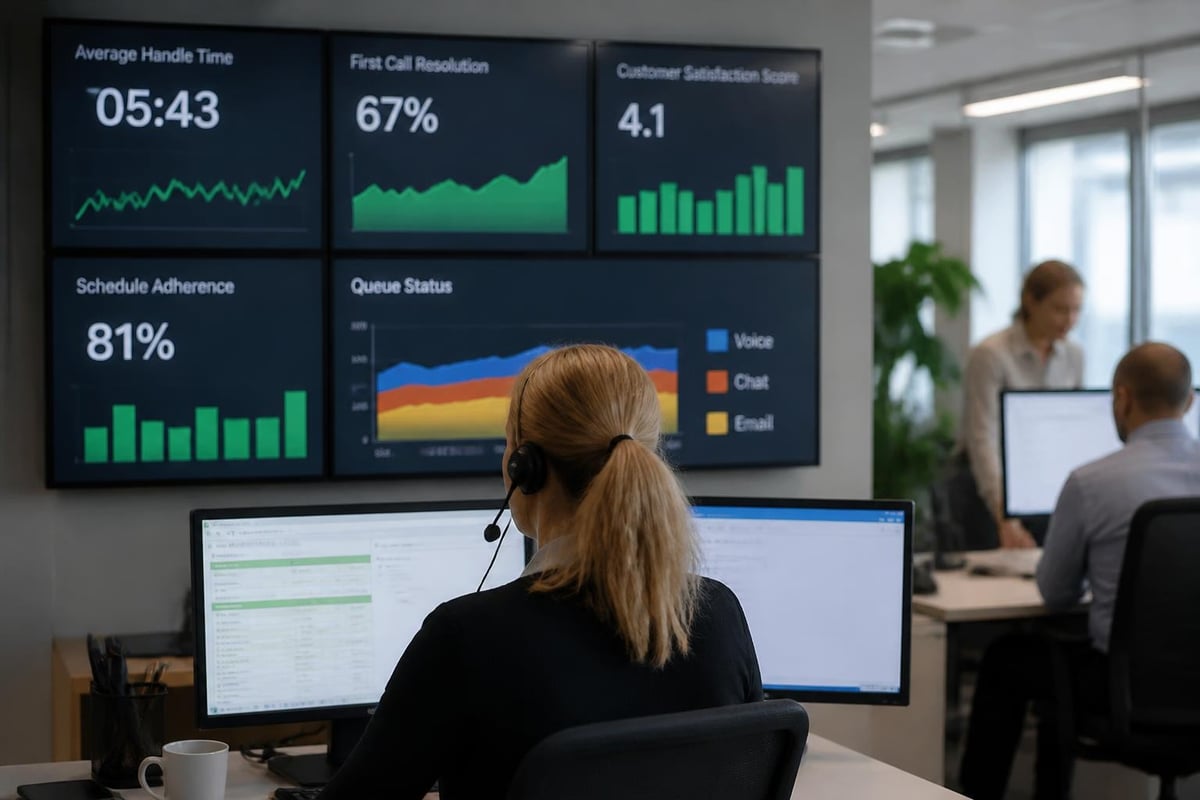
Supervisors analyze performance metrics continuously, identifying trends that signal training gaps or process bottlenecks. Key performance indicators monitored during supervisory call center duty include:
- Average handle time (AHT) and adherence to target ranges
- First call resolution (FCR) rates by agent and issue type
- Customer satisfaction (CSAT) and Net Promoter Scores (NPS)
- Schedule adherence and occupancy percentages
- Quality assurance scores from call evaluations
Modern contact centers leverage platforms like HELION that consolidate these metrics into unified dashboards, enabling supervisors to spot performance outliers and address issues before they escalate. ContactBabel's decision-makers' guide reveals that top-performing centers review agent scorecards daily rather than monthly, allowing for timely intervention.
Technology Integration in Modern Call Center Duty
Technology has fundamentally transformed call center duty over the past five years. Agents no longer work in isolation but collaborate with AI assistants, automated workflows, and integrated communication platforms that streamline routine tasks.
AI-Powered Agent Assistance
Generative AI tools now support agents during live interactions, suggesting responses, surfacing relevant knowledge articles, and even drafting follow-up emails. Forrester's analysis of generative AI in contact centers highlights how these tools reduce cognitive load and accelerate resolution times for complex inquiries.
For organizations operating call center services in multilingual markets, AI voice agents handle routine inquiries in local languages while seamlessly escalating nuanced conversations to human agents. This hybrid model allows agents to focus call center duty on high-value interactions requiring empathy and creative problem-solving.
Omnichannel Communication Management
Contemporary call center duty requires proficiency across voice, email, chat, SMS, and social media channels. Agents toggle between communication modes throughout their shifts, maintaining context as customers switch channels mid-conversation.
Integrated platforms consolidate these channels into unified agent desktops, preserving conversation history and customer data regardless of contact method. This omnichannel approach reduces repetition for customers and eliminates the frustration of explaining issues multiple times to different representatives.
Compliance and Security Responsibilities
Call center duty carries significant compliance obligations, particularly when handling sensitive customer data. Agents serve as the first line of defense against data breaches and privacy violations, making security awareness a critical component of daily responsibilities.
Data Protection and Privacy
Agents routinely access personally identifiable information (PII) including names, addresses, payment details, and health records. Their call center duty encompasses strict protocols for:
- Verifying customer identity before discussing account details
- Adhering to PCI-DSS standards during payment processing
- Recognizing and reporting potential fraud or social engineering attempts
- Properly disposing of printed materials containing sensitive data
- Maintaining confidentiality of customer interactions
The FTC's security guidance for businesses emphasizes that frontline employees require regular training on data handling procedures and breach response protocols. Organizations operating nearshore call center operations must ensure compliance standards remain consistent across geographic boundaries.
Quality Assurance and Regulatory Adherence
Quality assurance specialists monitor recorded interactions to verify compliance with industry regulations and company policies. Their call center duty includes:
- Evaluating calls against standardized quality rubrics
- Identifying script deviations that risk regulatory violations
- Documenting compliance failures for remedial training
- Calibrating evaluation criteria across QA teams to ensure consistency
Industries such as healthcare and finance impose additional regulatory requirements that shape daily call center duty. HIPAA compliance in healthcare call centers, for example, mandates specific training on protected health information and requires secure communication channels for all patient interactions.
Training and Skill Development
Continuous learning forms an essential component of call center duty at every level. The rapid pace of product changes, technology updates, and evolving customer expectations demands ongoing skill development for agents and supervisors alike.
New hire training typically spans 2-4 weeks and covers:
- Product knowledge and service catalog familiarization
- CRM and telephony system navigation
- Communication skills and de-escalation techniques
- Quality standards and performance expectations
- Compliance requirements and security protocols
Following initial onboarding, agents receive regular refresher training on new features, process updates, and skill enhancement. Many centers schedule weekly nesting sessions where new agents handle live interactions under supervisor observation, gradually building confidence before taking full call center duty independently.
| Training Type | Frequency | Duration | Delivery Method |
|---|---|---|---|
| New hire onboarding | Once | 2-4 weeks | Instructor-led, hands-on practice |
| Product updates | Monthly | 1-2 hours | Webinars, documentation review |
| Compliance refreshers | Quarterly | 1 hour | E-learning modules, assessments |
| Soft skills coaching | Ongoing | 30-60 min | One-on-one, side-by-side monitoring |
| System training | As needed | Variable | Sandbox practice, guided walkthroughs |

Managing Shift Work and Schedule Adherence
Call center duty often follows non-traditional schedules, with many centers operating 24/7 to support global customer bases. Agents work rotating shifts, weekends, and holidays, requiring careful workforce planning to maintain adequate coverage during peak periods.
Shift Scheduling and Workforce Management
Workforce management specialists forecast call volume based on historical patterns, seasonal trends, and planned marketing campaigns. They create agent schedules that balance service level targets against labor costs and employee preferences.
Agents bear responsibility for strict schedule adherence during their assigned call center duty hours. Arriving late, extending breaks, or logging out early directly impacts queue wait times and service level achievement. Real-time adherence monitoring alerts supervisors when agents deviate from scheduled activities, enabling quick intervention to prevent service degradation.
Work-Life Balance Considerations
The demanding nature of call center duty contributes to higher-than-average turnover rates in the industry. Forward-thinking organizations address this challenge through:
- Flexible scheduling options that accommodate personal commitments
- Shift-swapping platforms that empower agents to manage their own schedules
- Premium pay for less desirable shifts (late nights, weekends, holidays)
- Mental health resources and stress management programs
- Clear career progression pathways beyond frontline roles
Research from ContactBabel indicates that centers with formal flexibility programs experience 15-20% lower attrition compared to industry averages.
The Evolving Nature of Call Center Duty
Technological advancement continues reshaping the scope and requirements of call center duty. Automation handles an increasing share of routine transactions, elevating the complexity of interactions that reach human agents.
The Shift Toward Complex Problem-Solving
As self-service portals and chatbots resolve straightforward inquiries, agents increasingly focus call center duty on nuanced situations requiring judgment, empathy, and creative problem-solving. This shift raises skill requirements and transforms the agent role from transactional to consultative.
Academic research on generative AI in customer service reveals both opportunities and challenges in this transition. While AI assistance improves agent productivity and reduces cognitive burden, organizations must carefully manage the balance between automation efficiency and human connection.
Emerging Responsibilities
Modern call center duty now encompasses responsibilities that barely existed five years ago:
- Collaborating with AI assistants and knowing when to override automated suggestions
- Managing customer expectations around response times across asynchronous channels
- Maintaining brand voice consistency across text, voice, and social media
- Identifying opportunities for process improvement based on recurring customer pain points
- Serving as subject matter experts for AI training and knowledge base development
Agents who develop expertise in these emerging areas position themselves for advancement into specialized roles such as knowledge management, process optimization, or AI training coordination.
Measuring Success in Call Center Duty
Performance evaluation in call center environments relies on quantitative metrics balanced against qualitative assessments of customer experience. Understanding how success is measured helps agents prioritize their call center duty activities effectively.
Traditional metrics remain important but rarely tell the complete story:
- Average Handle Time measures efficiency but can incentivize rushing customers
- First Call Resolution indicates effectiveness but may discourage appropriate escalation
- Customer Satisfaction captures experience but suffers from low survey response rates
- Quality Scores assess adherence to standards but may overlook positive deviations
Leading contact centers adopt balanced scorecards that weight multiple dimensions equally, preventing agents from optimizing for a single metric at the expense of overall performance. Regular calibration sessions ensure evaluators apply quality standards consistently across teams and shifts.
Specialized Call Center Duty Functions
Beyond generalist agent roles, many contact centers employ specialists who handle specific call center duty functions requiring advanced expertise or certifications.
Technical support specialists manage complex troubleshooting that may span multiple customer interactions. Their call center duty involves deep product knowledge, diagnostic methodology, and often direct system access to investigate backend issues.
Collections specialists focus exclusively on payment recovery, balancing empathy with assertiveness to secure commitments from customers facing financial hardship. This specialized call center duty requires thick skin, negotiation skills, and thorough knowledge of fair debt collection practices.
Retention specialists intervene when customers initiate service cancellations, offering incentives and alternative solutions to preserve the relationship. Their call center duty demands quick thinking and authorization to extend offers beyond standard agent limits.
Quality analysts dedicate their call center duty to systematic review of recorded interactions, scoring calls against standardized rubrics and identifying coaching opportunities. They calibrate evaluation criteria, conduct agent feedback sessions, and report quality trends to leadership.
Mastering call center duty requires balancing multiple responsibilities, from frontline customer interaction to backend documentation and continuous skill development. Organizations that invest in comprehensive training, leverage technology effectively, and maintain reasonable performance expectations create environments where agents thrive and customers receive exceptional service. InfraWeb combines experienced contact center teams with the HELION platform's integrated AI capabilities to deliver consistent, high-quality support across inbound, outbound, and technical service channels. Whether you need 24/7 coverage for a growing customer base or specialized expertise in regulated industries, our Romanian-based operations provide the skilled workforce and advanced technology infrastructure to elevate your customer experience.