
The modern sales call center has evolved far beyond simple cold calling operations. Today's revenue-generating contact centers combine sophisticated technology platforms, strategic conversation design, and data-driven workforce management to drive measurable business outcomes. Organizations seeking to scale their sales efforts increasingly turn to specialized operations that blend human expertise with artificial intelligence, omnichannel engagement, and real-time analytics. Understanding how top-performing sales call centers operate reveals opportunities to transform customer acquisition and revenue growth in competitive markets.
Defining the Modern Sales Call Center
A sales call center is a specialized operation focused primarily on generating revenue through outbound calling campaigns, lead qualification, appointment setting, and direct sales conversations. Unlike customer service centers that handle inbound support inquiries, sales-focused operations prioritize prospecting, pipeline development, and closing transactions.
The distinction between sales and service centers has blurred in recent years as organizations recognize the value of equipping every customer interaction with revenue potential. Harvard Business Review research on structuring customer service calls demonstrates that well-designed conversation flows can simultaneously boost satisfaction and drive incremental sales, even within traditionally service-oriented interactions.
Key Functions and Objectives
Sales call centers typically perform several core functions:
- Lead generation and qualification: Initial outreach to prospects, gathering qualifying information, and assessing purchase readiness
- Appointment setting: Scheduling demonstrations, consultations, or meetings for field sales teams
- Direct sales: Completing transactions entirely over the phone, from presentation through payment processing
- Upselling and cross-selling: Contacting existing customers with complementary products or service upgrades
- Renewal campaigns: Proactive outreach to customers approaching contract expiration or subscription renewal dates
The primary objective remains consistent across these functions: converting conversations into measurable revenue outcomes. Success metrics center on conversion rates, average deal size, cost per acquisition, and revenue per agent hour.

Technology Infrastructure and Platform Requirements
The technology foundation determines operational capability and competitive advantage. Modern sales call centers require integrated platforms that connect telephony, customer data, conversation intelligence, and performance analytics.
Essential Platform Components
| Component | Purpose | Key Capabilities |
|---|---|---|
| Auto-dialer | Maximize agent talk time | Predictive dialing, local presence, call recycling |
| CRM integration | Centralize customer data | Real-time data access, automatic logging, lead scoring |
| Call recording & analytics | Quality and compliance | 100% recording, sentiment analysis, keyword detection |
| Scripting & prompts | Guide conversations | Dynamic scripts, objection handling, next-best-action |
| Workforce management | Optimize staffing | Forecasting, scheduling, real-time adherence |
Organizations operating outbound call center services must balance automation efficiency with conversation quality. Aggressive predictive dialing maximizes agent utilization but can create customer frustration if algorithms drop calls due to timing errors. Progressive or preview dialing modes offer more control at the expense of throughput.
The Microsoft reference architecture for contact center CRM integration provides valuable guidance on connecting telephony platforms with customer data systems. Proper integration ensures agents see complete customer history, previous interactions, and relevant contextual information before each conversation begins.
AI and Automation Capabilities
Artificial intelligence transforms sales call center operations in 2026 through multiple applications:
Voice AI agents handle initial qualification, schedule callbacks, and answer routine questions before routing qualified prospects to human agents. These systems converse naturally, recognize intent, and adapt responses based on prospect behavior. Organizations with multilingual requirements benefit from AI agents capable of conducting sales conversations in multiple languages while maintaining consistent messaging.
Real-time agent assist tools analyze ongoing conversations and surface relevant information, objection responses, or competitive positioning to agents during calls. This augmentation improves conversion rates while reducing training time for new representatives.
Post-call analytics leverage natural language processing to evaluate conversation quality, identify winning patterns, and flag compliance issues. Automated quality monitoring scales beyond the 2-3% sample rate typical of manual review programs.
Forrester research on generative AI in contact centers highlights the technology's potential to transform both agent productivity and customer experience. However, successful implementation requires careful prompt engineering, continuous model refinement, and human oversight of AI-generated content.
Operational Excellence and Workforce Management
Technology enables performance, but operational discipline determines results. Elite sales call centers distinguish themselves through rigorous workforce planning, performance management, and continuous optimization.
Forecasting and Scheduling
Accurate volume forecasting forms the foundation of effective workforce management. Sales call centers must predict:
- Available calling hours across time zones and geographic markets
- Contact rates by list quality, time of day, and day of week
- Conversation duration by campaign type and agent experience level
- Conversion rates by product, price point, and customer segment
ICMI's workforce management training provides comprehensive frameworks for forecasting contact center demand and building optimal schedules. The principles apply directly to sales operations with adjustments for outbound calling patterns and campaign-based workload variation.
Schedule adherence becomes particularly critical in sales environments where campaign timing affects results. Calling prospects during optimal hours maximizes contact rates and conversion probability. Missing scheduled calling blocks due to poor adherence wastes valuable list inventory and reduces revenue potential.
Performance Metrics and Management
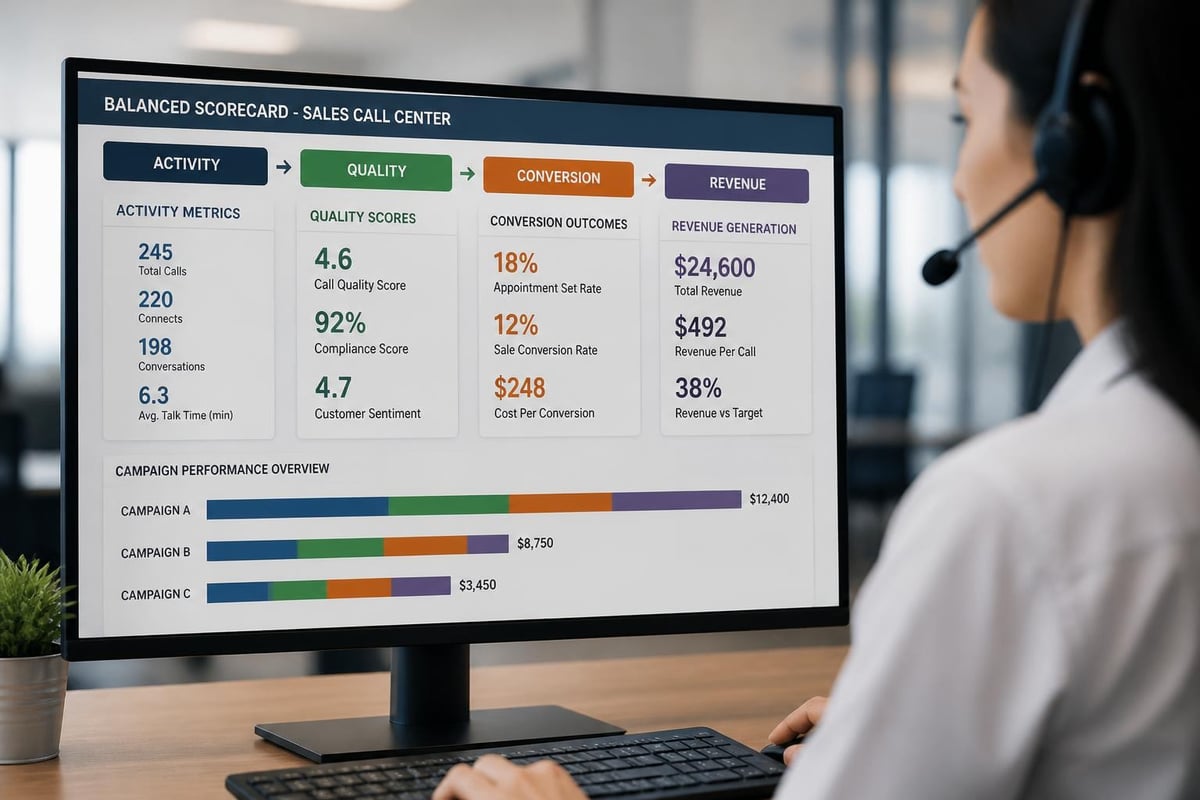
Sales call center management requires monitoring both activity metrics and outcome measures:
Activity metrics track operational efficiency:
- Calls per agent hour
- Talk time percentage
- Average handle time
- Contact and connection rates
Outcome metrics measure business impact:
- Conversion rate by stage
- Average deal size
- Revenue per agent hour
- Customer acquisition cost
- Pipeline value generated
Effective performance management balances these dimensions. Overemphasizing activity metrics drives high call volume but may sacrifice conversation quality and conversion rates. Focusing exclusively on conversions without regard for efficiency creates unnecessary cost.
Quality Assurance and Calibration
Consistent quality standards ensure every customer interaction reflects brand values and maximizes conversion probability. Structured quality assurance programs evaluate:
- Script adherence and conversation structure
- Product knowledge and accurate representation
- Objection handling and closing techniques
- Compliance with legal and regulatory requirements
- Professional communication and rapport building
Calibration sessions align evaluators on scoring standards and interpretation of quality criteria. Regular calibration prevents evaluator drift and ensures fair, consistent assessment across the entire sales team.
Compliance and Regulatory Considerations
Sales call center operations face significant regulatory obligations, particularly for outbound calling campaigns. Non-compliance creates substantial legal and financial risk while damaging brand reputation.
Telemarketing Sales Rule Requirements
The Federal Trade Commission's Telemarketing Sales Rule establishes foundational requirements for sales calling operations. Key provisions include:
- Do-Not-Call compliance: Maintaining internal suppression lists, honoring consumer requests, and scrubbing against the National Do Not Call Registry
- Time restrictions: Limiting calls to 8 AM to 9 PM in the recipient's time zone
- Disclosure requirements: Identifying the seller, describing products accurately, and clearly stating material terms
- Prohibited practices: Banning misrepresentations, unauthorized billing, and specific abusive tactics
The complete TSR regulatory text details obligations and provides examples of prohibited conduct. Organizations must implement systems and processes that ensure compliance across every campaign and conversation.
Call Recording and Consent
Recording requirements vary by jurisdiction. Many states require two-party consent before recording telephone conversations. Sales call centers must:
- Determine applicable legal requirements based on calling and receiving party locations
- Implement compliant recording notices and obtain necessary consent
- Store recordings securely with appropriate access controls
- Maintain recordings for required retention periods
- Provide recordings upon customer request where legally required
Beyond legal obligations, recorded conversations serve as valuable coaching tools, quality assurance evidence, and dispute resolution documentation. Modern platforms automatically log which recordings include proper consent disclosures.
Campaign Strategy and Optimization
Strategic campaign design separates high-performing sales call centers from mediocre operations. Success requires alignment between target audience, offer positioning, conversation structure, and follow-up processes.
List Quality and Segmentation
Campaign performance begins with contact list quality. Targeted, recently validated lists with accurate contact information and demographic data dramatically outperform generic purchased lists. Effective segmentation enables customized messaging that resonates with specific audience characteristics.
Consider these segmentation dimensions:
- Firmographic: Company size, industry, revenue, growth rate
- Behavioral: Website activity, content downloads, event attendance
- Technographic: Current technology stack, platform usage, vendor relationships
- Intent signals: Active research behavior, comparison shopping, review of competitive solutions
Layering multiple segmentation criteria creates highly targeted micro-segments that warrant customized conversation approaches. An enterprise prospect evaluating competitive alternatives requires different positioning than a small business becoming aware of a problem for the first time.
Conversation Design and Scripting
Effective sales conversations follow structured frameworks while allowing flexibility for natural interaction. Research on call structure and customer satisfaction demonstrates that specific conversation sequences improve both experience and conversion outcomes.
A well-designed sales conversation includes:
- Opening and permission: Introduce yourself, establish context, and confirm the prospect can speak
- Discovery: Ask questions to understand current situation, challenges, and priorities
- Positioning: Connect your solution to expressed needs and desired outcomes
- Handling objections: Address concerns with empathy and evidence
- Closing: Ask for the commitment and clarify next steps
Scripts should provide structure without sounding robotic. The best approaches offer agents flexibility within a proven framework rather than requiring word-for-word recitation.
Multi-Touch Campaign Orchestration
Single-call conversions become increasingly rare as purchase complexity increases. Modern sales call centers orchestrate multi-touch campaigns across voice, email, SMS, and social channels.
| Touch Point | Timing | Purpose | Success Metric |
|---|---|---|---|
| Initial call | Day 1 | Introduction and discovery | Contact rate, interest level |
| Follow-up email | Day 2 | Reinforce positioning, share resources | Open and click rates |
| Secondary call | Day 4-5 | Address questions, advance commitment | Conversion to next stage |
| SMS reminder | Day 7 | Prompt for scheduled demo or meeting | Response rate |
| Final outreach | Day 10 | Last attempt before list retirement | Salvage conversions |
Campaign orchestration requires coordination between outbound calling teams and automated marketing systems. Prospects should experience seamless, coordinated outreach rather than disconnected touches from different channels.

Building and Developing Sales Teams
Agent capability directly determines sales call center performance. Organizations must recruit effectively, onboard thoroughly, and develop continuously to maintain high-performing teams.
Recruitment and Selection
Successful sales agents demonstrate specific characteristics:
- Resilience: Managing rejection without losing motivation or quality
- Communication skills: Clear articulation, active listening, and conversational rapport
- Coachability: Accepting feedback and implementing improvements
- Goal orientation: Intrinsic motivation to achieve and exceed targets
- Product aptitude: Understanding complex offerings and explaining value clearly
Structured interviews with role-play scenarios, mock calls, and behavioral questions predict on-the-job performance better than resume credentials alone. Assessment tools measuring sales aptitude, communication style, and resilience provide additional predictive data.
Training and Development Programs
Comprehensive onboarding accelerates time-to-productivity and reduces early attrition. Effective programs combine:
- Product and industry knowledge: Deep understanding of solutions, competitive landscape, and customer challenges
- Sales methodology: Proven frameworks for discovery, positioning, and closing
- Systems and technology: Platform navigation, CRM usage, and workflow processes
- Compliance and ethics: Legal requirements, company policies, and professional standards
- Practice and certification: Simulated conversations, skill demonstrations, and competency validation
Ongoing development maintains and improves performance. Regular coaching sessions, advanced technique workshops, and peer learning opportunities prevent skill stagnation and address emerging challenges.
Measuring Success and ROI
Sales call center investment must demonstrate clear business value. Comprehensive measurement frameworks track operational efficiency, revenue outcomes, and strategic impact.
Financial Performance Metrics
Revenue and cost metrics provide the ultimate performance assessment:
Revenue metrics quantify top-line impact:
- Total revenue generated
- Revenue per agent hour
- Average deal size and win rate
- Pipeline value created
- Customer lifetime value of acquired accounts
Cost metrics measure efficiency:
- Cost per contact and cost per conversation
- Customer acquisition cost (CAC)
- Payback period on new customers
- Operating cost per agent hour
The ratio of customer lifetime value to acquisition cost (LTV:CAC) determines campaign sustainability. Healthy ratios exceed 3:1, indicating each acquired customer generates at least three times their acquisition cost in profit contribution.
Quality and Experience Measures
Financial results tell only part of the story. Quality metrics ensure sustainable, compliant operations:
- Quality assurance scores across evaluated dimensions
- Compliance violation rates and severity
- Customer complaint and escalation frequency
- Brand and reputation impact from sales outreach
Organizations offering comprehensive call center services available around the clock balance aggressive revenue targets with quality standards that protect long-term brand value and customer relationships.
Strategic Impact Assessment
Beyond immediate financial returns, successful sales call centers contribute strategic value:
- Market intelligence: Conversation insights revealing customer needs, competitive dynamics, and product gaps
- Testing laboratory: Rapid validation of messaging, positioning, and offer structures before broader deployment
- Scalability foundation: Proven processes and systems enabling rapid expansion into new markets or products
- Customer relationship foundation: Initial touchpoint establishing relationships that extend across customer lifecycle
Deloitte's contact center research demonstrates how leading organizations view their contact operations as strategic assets rather than cost centers. Sales call centers positioned this way attract investment, talent, and executive attention necessary for excellence.
Nearshore and Outsourced Models
Build versus buy decisions affect sales call center strategy. Organizations weigh in-house operation control against outsourced expertise, infrastructure, and cost advantages.
Outsourcing Benefits and Considerations
Outsourced sales call center partnerships offer several advantages:
- Rapid deployment: Existing infrastructure, technology, and trained agents enable faster program launch
- Variable cost structure: Usage-based pricing converts fixed overhead to variable expenses aligned with business volume
- Specialized expertise: Providers bring accumulated best practices, proven methodologies, and category experience
- Technology access: Enterprise-grade platforms and AI capabilities without capital investment
- Geographic flexibility: Access to labor markets with favorable cost profiles and multilingual capabilities
Nearshore locations provide particular value for organizations serving European markets. Nearshore call center services in Romania combine geographic proximity, cultural alignment, language capabilities, and competitive cost structures. Time zone overlap enables real-time collaboration while minimizing the coordination challenges of offshore partnerships.
Maintaining Quality and Alignment
Successful outsourcing relationships require active management. Organizations must:
- Define clear performance expectations: Establish measurable SLAs covering quality, productivity, and business outcomes
- Provide comprehensive enablement: Share product knowledge, competitive intelligence, and brand guidelines
- Monitor ongoing performance: Review scorecards, listen to call samples, and conduct regular business reviews
- Iterate and optimize: Treat the partnership as continuous improvement rather than set-and-forget arrangement
The best outsourcing partnerships function as true extensions of internal teams rather than arms-length vendor relationships. Regular communication, shared goals, and collaborative problem-solving drive superior results.
Future Trends and Evolution
Sales call center operations continue evolving as technology capabilities expand and customer expectations shift. Organizations must anticipate and adapt to emerging trends.
AI Integration Deepening
Artificial intelligence will handle increasingly complex sales interactions. Expect voice AI agents to:
- Conduct complete discovery conversations for straightforward products
- Qualify enterprise leads through sophisticated need assessment
- Schedule demonstrations and provide initial product education
- Handle routine objections and frequently asked questions
Human agents will focus on complex, high-value interactions requiring judgment, relationship building, and creative problem-solving. This division of labor optimizes both cost efficiency and conversion effectiveness.
Omnichannel Conversation Flows
Voice-only sales interactions become rare as customers expect seamless transitions between channels. Modern buyers might:
- Research solutions on mobile devices
- Initiate contact via web chat
- Schedule a call for detailed discussion
- Receive follow-up via email with customized proposals
- Complete purchase through self-service portal
- Engage post-sale support via SMS
Sales call centers must orchestrate these journeys rather than treating each channel independently. Platform capabilities that unify customer data, interaction history, and workflow coordination become essential rather than optional.
Predictive Analytics and Next-Best-Action
Advanced analytics will prescribe optimal actions in real-time based on prospect characteristics, behavioral signals, and historical patterns. Systems will recommend:
- Ideal contact timing based on prospect availability patterns
- Conversation approach tailored to personality type and communication preferences
- Optimal offer and pricing based on price sensitivity signals
- Next-best-action following each interaction outcome
These capabilities transform sales from art into science while preserving the human elements that drive connection and trust.
Modern sales call centers combine strategic campaign design, advanced technology platforms, operational excellence, and continuous improvement to drive sustainable revenue growth. Organizations seeking to scale their sales capabilities benefit from understanding both the foundational disciplines and emerging innovations shaping this field. Whether building internal capabilities or partnering with specialized providers, success requires commitment to quality, compliance, and customer-centric approaches. InfraWeb delivers complete contact center infrastructure combining human expertise with AI-powered platforms, enabling organizations to launch and scale effective sales operations with proven technology, multilingual capabilities, and strategic guidance tailored to your specific market and growth objectives.