
Businesses today face mounting pressure to deliver exceptional customer experiences while managing operational costs and scaling efficiently. Outsourced customer service solutions have emerged as a strategic approach for organizations seeking to balance quality, flexibility, and cost-effectiveness. Whether you're a startup experiencing rapid growth or an established enterprise looking to optimize support operations, understanding how to leverage external expertise can transform your customer experience strategy. This comprehensive guide explores the critical elements of successful outsourcing partnerships, technology integration, and performance management.
Understanding the Strategic Value of Outsourcing
Companies increasingly recognize that outsourced customer service solutions offer more than cost reduction. Strategic outsourcing delivers access to specialized talent, advanced technology platforms, and operational expertise that would require significant capital investment to develop in-house.
The economic advantages remain compelling. Organizations typically reduce operational costs by 30-50% while gaining flexibility to scale capacity up or down based on seasonal demand, product launches, or market fluctuations. Beyond direct savings, outsourcing eliminates recruiting costs, training overhead, infrastructure investment, and ongoing technology maintenance.
Access to Specialized Expertise
Outsourcing partners bring accumulated knowledge from serving multiple clients across industries. This cross-pollination of best practices enables continuous improvement and innovation that single-company teams rarely achieve.
Professional contact center providers invest heavily in agent training, quality assurance frameworks, and performance optimization. They maintain dedicated teams for workforce management, quality monitoring, and process improvement that most businesses cannot justify maintaining internally.

Geographic expansion becomes simpler when partnering with providers offering multilingual support and cultural familiarity with target markets. A nearshore call center operation, for example, can provide European language coverage with minimal time-zone challenges and cultural alignment.
Core Service Models and Engagement Options
Outsourced customer service solutions encompass several distinct engagement models, each suited to different business requirements and maturity levels.
Dedicated Team Model
In this arrangement, the provider assigns a team exclusively to your account. Agents work solely on your brand, developing deep product knowledge and customer relationships. This model suits businesses requiring specialized expertise, complex workflows, or stringent security requirements.
Key advantages include:
- Consistent agent experience and brand familiarity
- Easier integration with internal teams and processes
- Greater control over hiring, training, and performance standards
- Enhanced data security and intellectual property protection
The dedicated model typically commands premium pricing but delivers superior quality and cultural alignment.
Shared Services Model
Multiple clients share a pool of agents trained across various accounts. The provider schedules agents dynamically based on real-time demand across their client portfolio. This approach offers significant cost advantages and exceptional scalability.
Businesses benefit from immediate capacity expansion during peak periods without maintaining excess headcount during slower times. However, agent expertise may be less specialized, and quality consistency requires robust training and monitoring systems.
Hybrid Approaches
Many organizations combine both models, maintaining dedicated teams for complex inquiries or high-value customers while using shared resources for routine transactions and overflow situations. According to Forrester's 2025 CX predictions, hybrid models are increasingly popular as companies seek to balance cost, quality, and flexibility.
| Model Type | Best For | Cost Level | Quality Control | Scalability |
|---|---|---|---|---|
| Dedicated Team | Complex products, high security | Premium | Excellent | Moderate |
| Shared Services | High volume, routine inquiries | Lower | Good | Excellent |
| Hybrid | Variable workloads, mixed complexity | Medium | Very Good | Excellent |
Technology Integration and Platform Capabilities
Modern outsourced customer service solutions succeed or fail based on technology integration. The gap between outdated call center technology and contemporary customer expectations continues widening.
Leading providers invest in proprietary platforms that unify communication channels, automate routine tasks, and provide real-time visibility into operations. These systems integrate seamlessly with your existing CRM, helpdesk, and business intelligence tools.
Omnichannel Communication Infrastructure
Customers expect consistent experiences across voice, email, chat, social media, and messaging apps. Your outsourcing partner must manage conversations fluidly as customers switch between channels mid-interaction.
Advanced platforms track conversation history regardless of channel, enabling agents to provide contextualized support without asking customers to repeat information. This customer service outsourcing capability significantly improves satisfaction scores and first-contact resolution rates.
AI and Automation Integration
Artificial intelligence transforms outsourced contact center operations through intelligent routing, sentiment analysis, chatbots, and voice assistants. AI handles routine inquiries autonomously while escalating complex issues to human agents with full context and recommended solutions.
Natural language processing enables voice agents to understand intent, detect frustration, and respond appropriately in multiple languages. These capabilities extend support availability to 24/7 without proportional cost increases.
The COPC CX Standard provides frameworks for evaluating and certifying technology capabilities alongside operational processes, ensuring providers meet industry benchmarks for performance and customer experience delivery.
Selection Criteria for Outsourcing Partners
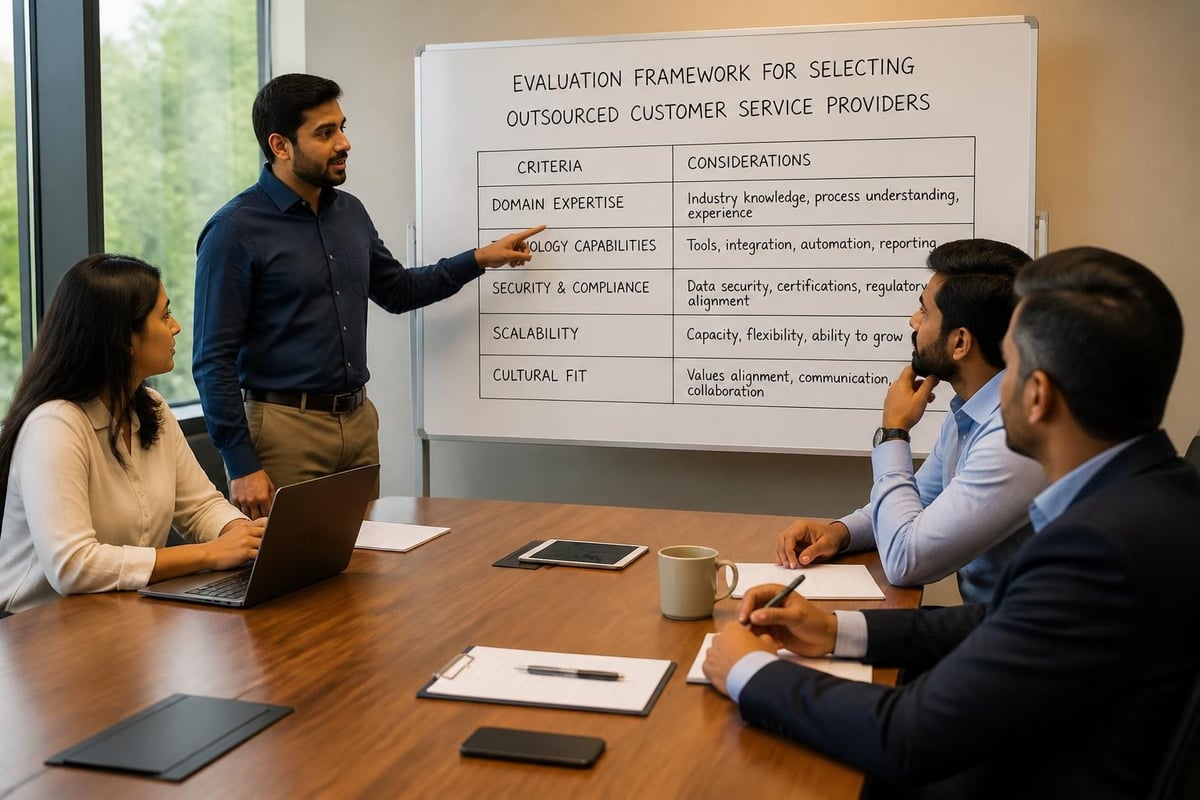
Choosing the right partner requires systematic evaluation across multiple dimensions. Many businesses focus narrowly on cost per contact, overlooking factors that determine long-term success.
Industry Experience and Vertical Expertise
Partners serving your industry understand specific regulatory requirements, customer expectations, and product complexities. A provider experienced in healthcare or finance brings valuable domain knowledge and pre-built compliance frameworks.
Request detailed case studies demonstrating successful engagements in your sector. Evaluate whether their existing client portfolio creates potential conflicts of interest or competitive concerns.
Security and Compliance Frameworks
Data protection regulations like GDPR impose strict requirements on how customer information is processed and stored. When outsourcing to providers in different countries, understanding data transfer mechanisms becomes critical.
The European Commission's Standard Contractual Clauses provide templates for ensuring adequate safeguards when transferring personal data outside the EU. Review your potential partner's certifications, data handling procedures, and willingness to accommodate specific security requirements.
Furthermore, EDPB guidance on cross-border data sharing clarifies obligations when working with third-country service providers, particularly relevant when evaluating offshore versus nearshore options.
Quality Assurance and Performance Management
- Monitoring Coverage: What percentage of interactions are monitored and evaluated?
- Calibration Process: How do they ensure consistent quality scoring across evaluators?
- Feedback Mechanisms: How quickly are performance issues identified and addressed?
- Reporting Transparency: What metrics are reported, at what frequency, and with what level of detail?
Request sample quality scorecards, performance dashboards, and SLA documentation. The ISO 18295 standard establishes requirements for both clients and contact center service providers, offering a framework for evaluating operational maturity.
Implementation and Transition Planning
Successful transitions from in-house to outsourced customer service solutions require meticulous planning and change management. Rushed implementations frequently result in service disruptions, knowledge gaps, and customer dissatisfaction.
Knowledge Transfer and Documentation
Begin by documenting your current processes, scripts, escalation paths, and product information. Many businesses discover their tribal knowledge is poorly documented when attempting to transfer it to an external partner.
Create comprehensive training materials including:
- Product catalogs with detailed specifications
- Common customer scenarios and resolution paths
- Brand voice guidelines and communication standards
- System access procedures and security protocols
- Escalation matrices and internal contact directories
Allow adequate time for the outsourcing partner to absorb this information, ask clarifying questions, and develop customized training programs for their agents.
Phased Rollout Strategy
Rather than transitioning all volume immediately, implement a phased approach that manages risk and allows course correction:
Phase 1: Pilot program with limited volume and lower-complexity interactions
Phase 2: Gradual volume increase with continuous quality monitoring
Phase 3: Full volume transfer with ongoing optimization
Maintain your internal team during early phases to handle overflow, provide consultation, and serve as escalation resources. This overlap period, while costly, significantly reduces implementation risk.
Communication and Stakeholder Management
Internal stakeholders often resist outsourcing due to concerns about job security, quality degradation, or loss of control. Address these concerns proactively through transparent communication about rationale, expected outcomes, and new roles for internal team members.
Customer communication matters equally. For complex B2B relationships or high-value customers, consider notifying key accounts about the transition and introducing their dedicated support contacts.
Performance Metrics and Continuous Improvement
Effective governance of outsourced customer service solutions depends on establishing clear metrics, regular review cadences, and continuous improvement processes.
Essential KPIs and Service Levels
| Metric Category | Key Indicators | Industry Benchmark |
|---|---|---|
| Efficiency | Average Handle Time, First Contact Resolution | 80%+ FCR |
| Accessibility | Service Level, Abandonment Rate | 80/20 (80% in 20 sec) |
| Quality | Quality Assurance Score, Customer Satisfaction | 90%+ QA, 85%+ CSAT |
| Business Impact | Net Promoter Score, Customer Effort Score | 30+ NPS |
Define realistic targets based on your industry, customer expectations, and service complexity. Overly aggressive SLAs incentivize undesirable behaviors like rushing customers or avoiding difficult issues.
Regular Business Reviews and Optimization
Schedule monthly operational reviews examining trends, root causes of issues, and improvement opportunities. Quarterly business reviews should assess strategic alignment, technology roadmap, and contract performance.
The Harvard Business Review report on customer experience emphasizes that successful outsourcing relationships require active partnership rather than passive vendor management. Treat your provider as an extension of your team, sharing customer insights, business objectives, and collaborative problem-solving.

Voice of Customer Integration
Customer feedback should inform training priorities, process refinements, and technology investments. Implement systematic feedback collection across all interaction channels and share insights regularly with your outsourcing partner.
Many organizations discover that combining call center services available 24/7 with robust analytics platforms creates unprecedented visibility into customer needs, pain points, and opportunities for product or service improvements.
Emerging Trends and Future Considerations
The landscape for outsourced customer service solutions continues evolving rapidly as technology capabilities advance and customer expectations shift.
AI-Human Collaboration Models
Rather than replacing human agents, artificial intelligence increasingly augments their capabilities. AI systems provide real-time suggestions, summarize customer history, predict intent, and automate after-call work. This collaboration enables agents to handle more complex inquiries while AI manages routine tasks.
Voice AI capable of natural conversation in multiple languages expands accessibility without proportional headcount increases. These systems learn continuously from successful interactions, improving accuracy and naturalness over time.
Vertical Specialization
Generic contact centers are giving way to specialized providers with deep expertise in specific industries or service types. TechTarget's analysis of contact center outsourcing highlights how specialization drives better outcomes through accumulated knowledge, purpose-built processes, and industry-specific technology integrations.
Businesses benefit from providers who understand their regulatory environment, speak their technical language, and bring proven solutions to common challenges.
Outcome-Based Pricing Models
Traditional per-hour or per-contact pricing is evolving toward outcome-based models that align provider incentives with business results. Compensation might be tied to customer satisfaction scores, retention rates, upsell success, or issue resolution quality rather than simple volume metrics.
These arrangements require sophisticated measurement systems and longer-term relationships but create true partnerships focused on mutual success.
Building Long-Term Partnership Success
Sustainable outsourced customer service solutions depend on relationships built on trust, transparency, and shared objectives. The most successful arrangements transcend transactional vendor relationships to become strategic partnerships.
Governance and Collaboration Structures
Establish clear governance including executive sponsorship, operational working groups, and escalation paths. Regular touchpoints at multiple organizational levels ensure alignment and rapid issue resolution.
Create shared objectives and celebrate joint successes. When your outsourcing partner shares in wins, they become invested in your success beyond contractual obligations.
Innovation and Continuous Evolution
Customer expectations and competitive landscapes constantly change. Your outsourcing partner should proactively recommend improvements, test new approaches, and invest in emerging capabilities that benefit your business.
Encourage experimentation through pilot programs, innovation challenges, and shared learning initiatives. The best providers bring insights from across their client portfolio while respecting confidentiality and competitive boundaries.
Cultural Alignment and Values Integration
Technology and processes matter, but cultural fit ultimately determines relationship longevity. Evaluate potential partners' values, communication styles, and approach to problem-solving. Misalignment in these areas creates friction that undermines operational excellence.
When working with nearshore providers, cultural similarities often facilitate smoother collaboration than purely cost-driven offshore selections. Time zone overlap, language proficiency, and cultural affinity simplify day-to-day interactions and reduce misunderstandings.
Successfully implementing outsourced customer service solutions requires careful partner selection, robust technology integration, and ongoing performance management. Organizations that approach outsourcing strategically unlock significant operational efficiencies while maintaining or improving customer satisfaction. InfraWeb delivers comprehensive contact center capabilities through advanced platforms integrating AI voice agents, omnichannel communication, and seamless CRM connectivity. With operations designed for European businesses and expertise across industries, InfraWeb transforms customer service from a cost center into a competitive advantage.