
Business communication infrastructure has undergone a dramatic transformation over the past decade. Companies no longer need to invest hundreds of thousands in physical equipment, dedicated server rooms, and IT teams to operate professional customer service operations. Hosted contact center solutions have democratized access to enterprise-grade communication tools, enabling organizations of all sizes to deliver exceptional customer experiences without the traditional capital expenditure and operational complexity associated with on-premise systems.
Understanding Hosted Contact Center Architecture
Hosted contact center solutions operate on cloud-based infrastructure managed by service providers rather than in-house IT departments. This fundamental shift moves the responsibility for hardware maintenance, software updates, security patches, and system uptime from the client organization to the hosting provider.
The architecture typically consists of several integrated components working in harmony. Voice routing engines handle call distribution based on predetermined rules and agent availability. Customer relationship management systems store interaction history and customer data. Quality monitoring tools record and analyze conversations for training and compliance purposes.
Key Infrastructure Components
Modern hosted platforms incorporate multiple technologies that function as a unified ecosystem:
- Automatic Call Distribution (ACD) systems route incoming contacts to the most appropriate agents
- Interactive Voice Response (IVR) menus guide customers through self-service options
- Computer Telephony Integration (CTI) links phone systems with desktop applications
- Workforce management tools forecast volume and optimize agent scheduling
- Analytics dashboards provide real-time and historical performance metrics
Security layers protect sensitive customer information through encryption, access controls, and compliance frameworks. PCI DSS standards govern how contact centers handle payment card data, requiring specific security measures for hosted environments processing financial transactions.

Cost Advantages and Financial Flexibility
Traditional on-premise contact centers required substantial upfront investment in telephony hardware, servers, and software licenses. Organizations faced capital expenditures ranging from $50,000 to $500,000 depending on scale, before hiring a single agent or handling the first customer call.
Hosted contact center solutions transform this financial model completely. Organizations pay subscription fees based on usage, typically calculated per agent seat per month. This operational expense structure eliminates large capital outlays and converts fixed costs into variable expenses that scale with business needs.
Comparative Cost Analysis
| Cost Category | On-Premise | Hosted Solution |
|---|---|---|
| Initial Setup | $100,000-$500,000 | $0-$10,000 |
| Monthly Per-Agent | $50-$100 (maintenance only) | $75-$150 (all-inclusive) |
| Hardware Refresh | $50,000-$150,000 every 5 years | Included |
| IT Staff Required | 2-5 dedicated personnel | 0-1 administrator |
| Disaster Recovery | Additional $30,000-$100,000 | Included |
The subscription model also provides predictable budgeting. Organizations know exactly what they'll spend each month based on active agent seats and selected features. No surprise hardware failures or emergency equipment purchases disrupt financial planning.
Scalability costs represent another significant advantage. Adding 10 agents to an on-premise system might require additional hardware investments and weeks of deployment time. Hosted platforms enable provisioning new agents in hours or days, with costs proportional to usage.
Advanced Feature Sets and Capabilities
The competitive landscape among hosted contact center solution providers drives continuous innovation and feature expansion. Capabilities once exclusive to enterprise systems costing millions now appear as standard features in mid-market solutions.
Omnichannel routing represents one of the most significant advances in customer service technology. Rather than managing separate systems for voice, email, chat, social media, and SMS, organizations operate from unified queues. Agents handle multiple communication channels from a single interface, with full conversation history visible regardless of how customers initiated contact.
AI Integration and Automation
Artificial intelligence capabilities now permeate hosted contact center solutions at multiple levels. Research by Forrester indicates that AI-powered tools are fundamentally reshaping customer service operations, with intelligent agents handling increasingly complex interactions.
Contemporary AI implementations include:
- Conversational AI agents that handle routine inquiries without human intervention
- Sentiment analysis tools that detect customer frustration and route to specialized teams
- Real-time agent assistance suggesting responses and next-best actions during live interactions
- Predictive routing that matches customers with agents based on historical success patterns
- Automated quality monitoring that scores 100% of interactions rather than random samples
Advanced analytics powered by large language models enable contact centers to extract insights from vast quantities of unstructured conversation data, identifying emerging issues, training opportunities, and process improvements without manual review.
Voice analytics transcribe and analyze spoken conversations, identifying compliance violations, competitive mentions, and emotional tone. These systems flag coaching opportunities and highlight exceptional performance for recognition and best-practice sharing.
Implementation Strategies and Best Practices
Successful deployment of hosted contact center solutions requires thoughtful planning despite their relative simplicity compared to on-premise alternatives. Organizations that rush implementation often encounter adoption resistance, process gaps, and underutilized features.
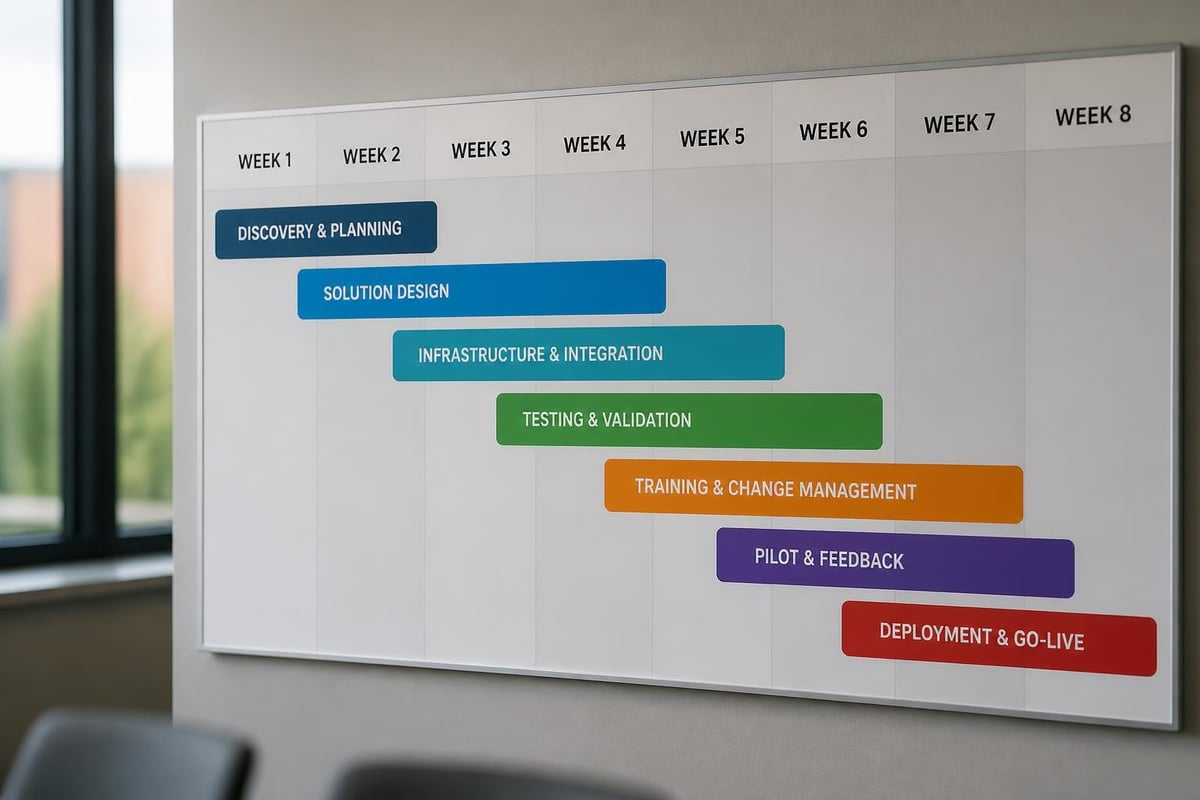
The transition timeline typically spans six to twelve weeks for most organizations, though simple deployments may complete in two to four weeks. Complex migrations from legacy systems with extensive customizations may require three to six months.
Phased Deployment Approach
Prudent organizations adopt staged rollouts rather than wholesale replacements:
Phase 1 (Weeks 1-2): Requirements gathering and vendor selection. Document current processes, volumes, and integration needs. Evaluate providers based on features, pricing, and support capabilities.
Phase 2 (Weeks 3-4): System configuration and integration testing. Set up routing rules, configure IVR menus, establish quality monitoring parameters, and test connections with existing CRM and ticketing systems.
Phase 3 (Weeks 5-6): Agent training and pilot testing. Train a small team on the new platform and run parallel operations with legacy systems. Gather feedback and refine configurations.
Phase 4 (Weeks 7-8): Full deployment and optimization. Migrate all agents to the hosted platform and decommission old systems. Monitor performance closely and make adjustments based on real-world usage patterns.
Change management deserves particular attention during transitions. Agents accustomed to familiar systems often resist new interfaces and workflows. Involving front-line staff in configuration decisions increases buy-in and identifies practical concerns that management might overlook.
Integration Ecosystems and Platform Connectivity
Hosted contact center solutions deliver maximum value when seamlessly integrated with existing business systems. Standalone communication platforms create data silos and require manual information transfer between applications, negating many efficiency benefits.
Modern platforms offer pre-built connectors for popular business applications. Salesforce, Microsoft Dynamics, HubSpot, Zendesk, and ServiceNow integrations enable automatic screen pops displaying customer information when calls arrive. Agents view purchase history, previous interactions, and account status without switching applications or asking customers to repeat information.
Critical Integration Points
| System Type | Integration Benefit | Implementation Complexity |
|---|---|---|
| CRM Platforms | Unified customer view, automatic logging | Low (pre-built connectors) |
| Ticketing Systems | Case creation, status updates | Low to Medium |
| Payment Processors | Secure card handling, PCI compliance | Medium (security requirements) |
| Chat Platforms | Omnichannel queuing, conversation history | Low |
| Analytics Tools | Centralized reporting, business intelligence | Medium to High |
API availability enables custom integrations when pre-built connectors don't exist. Organizations with proprietary systems or specialized applications can develop tailored connections, though this requires development resources and ongoing maintenance as platforms evolve.
Webhook capabilities allow hosted contact center solutions to trigger actions in external systems based on specific events. When a call ends, the platform can automatically create support tickets, send notification emails, update database records, or initiate follow-up workflows without manual intervention.
Security, Compliance, and Reliability Considerations
Entrusting customer communications to third-party hosted platforms raises legitimate security and compliance questions. Organizations handling sensitive information or operating in regulated industries must thoroughly evaluate provider capabilities in these areas.
Data encryption protects information both in transit and at rest. Industry-standard TLS protocols secure connections between agents and hosted platforms, while AES-256 encryption safeguards stored recordings, transcripts, and customer data. Multi-factor authentication prevents unauthorized access even if passwords are compromised.
Regulatory Compliance Requirements
Different industries face distinct compliance obligations that hosted contact center solutions must support:
- Financial services require adherence to regulations like GLBA, PCI DSS, and SOX for handling customer financial data
- Healthcare organizations must maintain HIPAA compliance for protected health information shared during customer interactions
- European operations demand GDPR compliance for personal data processing and storage
- Public companies need SOC 2 Type II audits verifying security controls and operational procedures
Reputable providers undergo regular third-party audits and maintain certifications demonstrating compliance with relevant standards. Organizations should request attestation reports and verify that provider security practices align with their own requirements.
Geographic data residency has emerged as a critical consideration as data sovereignty laws proliferate globally. Some regulations require that customer data remain within specific geographic boundaries. Nearshore contact center arrangements can address these concerns by keeping operations and data within regional boundaries while still leveraging hosted platforms.
Disaster Recovery and Business Continuity
Hosted contact center solutions offer inherent disaster recovery advantages over on-premise systems. When floods, fires, power outages, or other disasters strike physical locations, cloud-based platforms continue operating unaffected by local conditions.
Geographic redundancy distributes infrastructure across multiple data centers in different regions. If one facility experiences issues, traffic automatically routes to functioning locations without service interruption. This redundancy would cost hundreds of thousands to implement in traditional contact center architectures.
Agent flexibility further enhances business continuity. Because hosted solutions operate via internet connections rather than dedicated phone lines, agents can work from anywhere with adequate bandwidth. During emergencies like the COVID-19 pandemic, organizations with hosted platforms transitioned to remote work in days, while those with on-premise systems struggled for weeks or months.

Performance Monitoring and Continuous Improvement
Sophisticated analytics distinguish hosted contact center solutions from basic phone systems. Comprehensive dashboards provide visibility into operations at individual, team, and organizational levels.
Real-time wallboards display current queue depths, average wait times, service levels, and agent status. Supervisors identify developing problems before they escalate, reassigning resources or adjusting routing to maintain service quality during unexpected volume spikes.
Historical reporting reveals patterns and trends invisible in real-time views. Month-over-month comparisons highlight seasonal variations, helping workforce planners staff appropriately. Year-over-year analysis demonstrates the impact of process changes and technology investments.
Key Performance Indicators
Effective contact center management requires tracking specific metrics that drive business outcomes:
- Average Handle Time (AHT) - Total duration including talk time and after-call work
- First Call Resolution (FCR) - Percentage of issues resolved without follow-up contact
- Service Level - Percentage of calls answered within target timeframes
- Occupancy Rate - Portion of agent time actively handling contacts versus waiting
- Customer Satisfaction (CSAT) - Direct feedback collected through post-interaction surveys
- Net Promoter Score (NPS) - Likelihood that customers would recommend the organization
Quality monitoring tools built into hosted platforms enable systematic evaluation of agent performance. Automated scoring analyzes adherence to scripts, regulatory compliance, and soft skills like empathy and active listening. Targeted coaching addresses specific development needs rather than generic training applied uniformly.
Vendor Selection Criteria and Evaluation
The hosted contact center solutions market includes dozens of providers with varying capabilities, pricing models, and specializations. Thorough evaluation prevents costly mistakes and ensures selected platforms align with organizational needs.
Feature parity checking compares specific capabilities across vendors. Create detailed requirement lists including must-have features, nice-to-have enhancements, and future needs. Some providers excel at omnichannel routing while others specialize in workforce management or advanced analytics.
Evaluation Framework
| Criteria | Weight | Evaluation Questions |
|---|---|---|
| Core Features | 25% | Does it include all required channels and routing capabilities? |
| Integration Capability | 20% | Can it connect with existing CRM, ticketing, and business systems? |
| Scalability | 15% | How easily can we add agents, channels, or features as we grow? |
| Pricing Transparency | 15% | Are costs clear with no hidden fees or surprise charges? |
| Support Quality | 15% | What support hours, response times, and channels are included? |
| Security & Compliance | 10% | Does it meet our industry-specific regulatory requirements? |
Trial periods provide invaluable hands-on experience before committing to multi-year contracts. Most providers offer 14 to 30-day trials allowing organizations to test platforms with actual agents handling real customer interactions. This practical evaluation often reveals usability issues or missing features not apparent during sales demonstrations.
Reference checks with existing customers uncover insights vendors won't volunteer. Ask about implementation challenges, ongoing support responsiveness, unexpected costs, and whether they would select the same provider again knowing what they know now.
For organizations requiring specialized capabilities like multilingual support, industry-specific workflows, or advanced AI features, providers with relevant expertise deliver better outcomes. Companies seeking call center services available 24x7 benefit from partners operating multiple shifts across time zones, ensuring continuous coverage without requiring individual organizations to staff overnight operations.
Future Trends Shaping Hosted Contact Centers
The trajectory of hosted contact center solutions points toward increased automation, deeper personalization, and tighter integration with broader customer experience ecosystems. Several emerging trends will reshape the landscape through 2026 and beyond.
Predictive engagement proactively initiates customer contact based on behavioral signals rather than waiting for inbound requests. When website analytics detect browsing patterns indicating confusion or frustration, systems automatically offer assistance via chat or callback. This shift from reactive to proactive support improves customer satisfaction while often resolving issues before they escalate.
Emotion AI analyzes voice characteristics, word choice, and conversation patterns to detect customer emotional states. Systems recognize frustration, confusion, or satisfaction in real-time, enabling dynamic responses. Frustrated customers automatically route to senior agents or receive priority handling. Positive interactions trigger cross-sell offers or satisfaction surveys.
Agent augmentation through AI assistance will accelerate significantly. Rather than replacing human agents, artificial intelligence serves as a real-time coach and assistant. During customer conversations, AI systems suggest relevant knowledge articles, recommend next-best actions, flag potential compliance issues, and even draft response options that agents can customize and send.
Hyper-personalization leverages customer data to customize every interaction. Systems recognize callers automatically, surface relevant history, and tailor conversations based on preferences, past issues, and predicted needs. This level of personalization was once exclusive to high-touch luxury services but now scales across entire customer bases through automation.
Hosted contact center solutions represent a fundamental advancement in how organizations deliver customer service, combining enterprise capabilities with subscription economics and unprecedented flexibility. By eliminating infrastructure barriers, these platforms enable businesses to focus resources on what truly matters: creating exceptional customer experiences that drive loyalty and growth. InfraWeb combines the advantages of hosted technology with the expertise of dedicated contact center professionals, delivering comprehensive solutions that span inbound support, outbound campaigns, and technical helpdesk services powered by our proprietary HELION platform with integrated AI voice agents.