
Quality in call center operations defines the competitive edge that separates exceptional customer experiences from mediocre interactions. As customer expectations continue rising in 2026, organizations must prioritize systematic approaches to measuring, managing, and improving every customer touchpoint. The challenge extends beyond simple call monitoring to encompass comprehensive frameworks that align agent performance, technology capabilities, and strategic business objectives. Understanding how to build and sustain quality programs requires insights into modern methodologies, advanced measurement techniques, and the integration of emerging technologies like artificial intelligence.
Defining Quality in Call Center Environments
Quality represents more than accuracy or compliance. It encompasses the entire customer experience, from first contact through resolution and follow-up.
Modern quality programs evaluate multiple dimensions:
Customer satisfaction and effort scores
First-contact resolution rates
Adherence to compliance standards
Brand voice and empathy demonstration
Problem-solving effectiveness
Technical accuracy and knowledge application
Organizations that adopt operational performance management frameworks establish clear benchmarks for measuring these dimensions consistently. Quality in call center settings requires balancing efficiency metrics with experience indicators, ensuring agents don't sacrifice relationship-building for speed.

The Business Impact of Quality Programs
Investing in quality yields measurable returns across multiple business areas. Research consistently demonstrates that superior customer experience correlates directly with revenue growth, customer retention, and reduced operational costs.
According to Forrester's 2024 Customer Experience Index, companies excelling in CX outperform laggards significantly in financial performance. Quality in call center operations drives these outcomes by reducing repeat contacts, minimizing escalations, and building customer loyalty.
Business Metric | Impact of Quality Programs |
|---|---|
Customer retention | 15-25% improvement |
Average handle time | 10-18% reduction |
Agent turnover | 20-30% decrease |
Net Promoter Score | 25-40 point increase |
Beyond quantitative measures, quality programs create cultural benefits. Agents working within structured quality frameworks report higher job satisfaction, clearer performance expectations, and stronger professional development pathways.
Building a Comprehensive Quality Assurance Framework
Effective QA programs require structured methodologies that capture representative samples, apply consistent evaluation criteria, and translate findings into actionable improvements.
The foundation begins with defining evaluation criteria aligned to business priorities. InfraWeb develops customized scorecards reflecting client-specific requirements, regulatory obligations, and brand standards. These scorecards typically include 15-25 evaluation points weighted by strategic importance.
Sample scoring categories include:
Opening and authentication procedures
Active listening and needs assessment
Solution accuracy and completeness
Compliance and regulatory adherence
Empathy and relationship building
Closing and next-step clarification
Calibration Sessions and Evaluator Consistency
Quality suffers when evaluators apply inconsistent standards. Regular calibration sessions ensure all QA specialists interpret scoring criteria identically.
Monthly calibration typically involves:
Reviewing 3-5 sample interactions collectively
Scoring independently before group discussion
Identifying interpretation gaps
Documenting scoring guidelines
Tracking inter-rater reliability metrics
Organizations should target 85% or higher agreement between evaluators on overall scores. Discrepancies reveal opportunities to refine evaluation language, add examples, or provide additional evaluator training.
Leveraging Technology for Quality Monitoring
Traditional manual QA sampling captures only 1-3% of interactions. Technology enables comprehensive coverage while reducing evaluator workload.
Speech Analytics and Automated Monitoring
Modern speech analytics platforms transcribe and analyze 100% of voice interactions, identifying compliance risks, sentiment patterns, and coaching opportunities automatically. These systems detect keywords, phrases, and conversational patterns indicating quality issues.
Key capabilities include:
Automatic compliance phrase detection
Sentiment analysis and emotion tracking
Dead air and silence identification
Script adherence measurement
Competitive mention flagging
Integration with CRM and ticketing systems provides context for quality evaluation. When platforms like HELION combine AI voice agents with comprehensive analytics, organizations gain unified visibility across human and automated interactions.

AI-Powered Quality Prediction
Emerging approaches use machine learning to predict customer satisfaction from interaction characteristics. Recent research demonstrates that models can anticipate CSAT scores with significant accuracy, enabling proactive intervention before dissatisfaction escalates.
Quality in call center operations increasingly relies on these predictive capabilities, allowing supervisors to identify at-risk interactions for immediate review or follow-up. The COPC Standards Committee continues updating guidance on AI governance and quality measurement in automated environments.
Agent Development Through Quality Coaching
Quality data transforms into performance improvement only when delivered through effective coaching programs. The most successful organizations view QA as a development tool rather than punitive enforcement.
Coaching Session Structure
Productive coaching sessions follow consistent frameworks that emphasize learning and skill building:
Preparation: Review evaluation scores, identify specific examples, determine coaching focus
Discussion: Agent self-assessment before sharing evaluation results
Gap Analysis: Collaborative identification of performance gaps
Skill Building: Targeted practice on specific behaviors
Action Planning: Documented commitments and follow-up schedule
Frequency matters significantly. Weekly coaching sessions for new agents transition to bi-weekly or monthly sessions for experienced performers. High-risk or struggling agents may require daily coaching until performance stabilizes.
Agent Tenure | Recommended Coaching Frequency | Focus Areas |
|---|---|---|
0-90 days | Weekly | Foundational skills, process adherence |
90-180 days | Bi-weekly | Efficiency, advanced techniques |
180+ days | Monthly | Consistency, mentoring opportunities |
Performance improvement | Daily/Weekly | Specific skill gaps, compliance |
Creating a Continuous Learning Culture
Beyond individual coaching, quality programs should incorporate team-based learning opportunities. Regular team meetings reviewing anonymized quality examples allow peer learning and collective problem-solving.
Recognition programs celebrating quality achievements reinforce desired behaviors. Public acknowledgment of exceptional evaluations, customer compliments, and consistent improvement motivates broader team engagement.
Quality Metrics and Performance Measurement
Selecting appropriate metrics ensures quality programs align with strategic objectives while remaining actionable for frontline teams.
Core Quality Metrics
Primary indicators include:
Quality score: Aggregate evaluation score across all assessed dimensions
Fatal error rate: Percentage of interactions containing critical compliance or accuracy failures
Customer satisfaction (CSAT): Post-interaction survey results
Net Promoter Score (NPS): Customer likelihood to recommend
First-contact resolution (FCR): Percentage of issues resolved without follow-up
Organizations serving healthcare or finance sectors must track compliance-specific metrics including authentication completion rates, disclosure adherence, and data protection protocol observance.
Balanced Scorecards
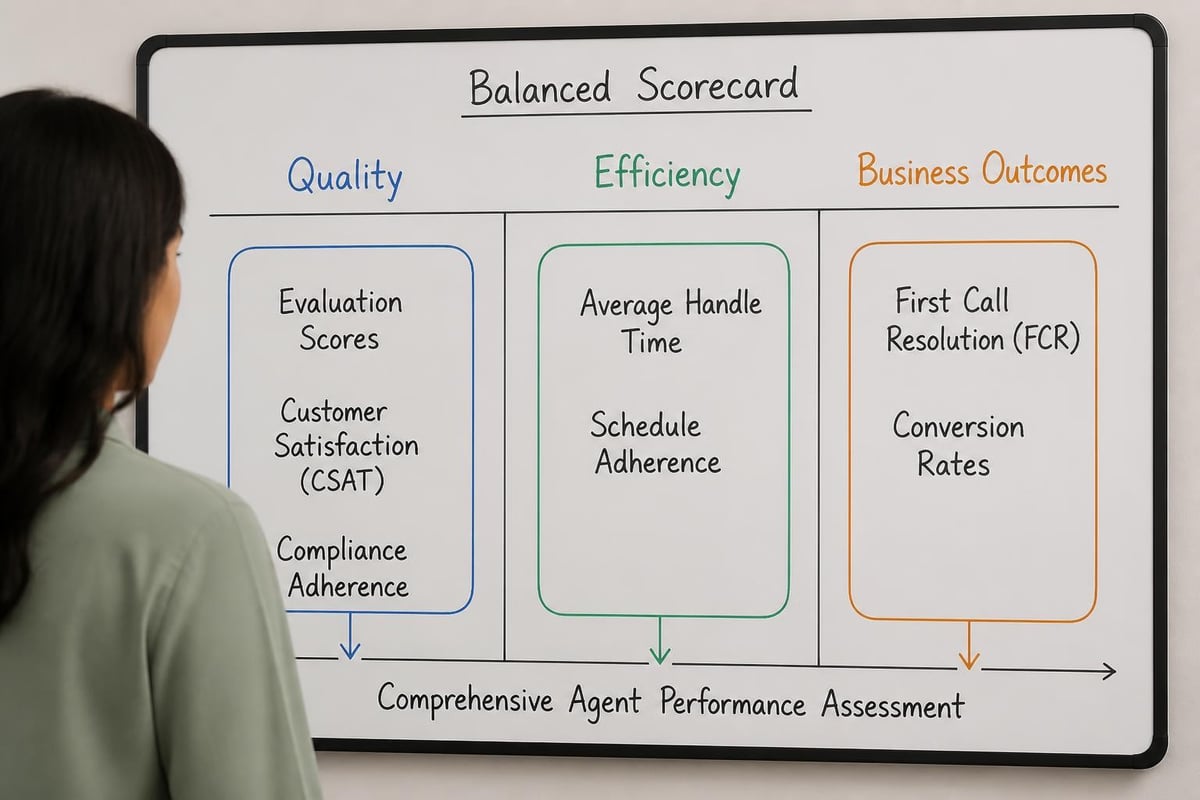
Quality shouldn't exist in isolation from operational metrics. Balanced scorecards integrate quality measures with efficiency indicators, creating holistic performance views.
For example, an agent achieving 98% quality scores but consistently exceeding handle time targets may require efficiency coaching. Conversely, agents with exceptional speed but declining quality scores need accuracy focus. Organizations offering call center services balance these dimensions to optimize both customer experience and operational efficiency.
Implementing Best Practices for 2026
Industry leaders have identified several practices that consistently elevate quality in call center operations. CMSWire's quality assurance guidance and CX Today's recommendations converge on similar themes.
Sample Size and Statistical Validity
Many organizations evaluate too few interactions to generate statistically meaningful insights. Minimum sample sizes should reflect population size and desired confidence levels.
For teams under 20 agents, evaluate at least 5-8 interactions per agent monthly. Larger teams may reduce per-agent sampling to 3-5 interactions while maintaining statistical validity through volume.
Sampling strategies include:
Random sampling: Automated selection across all interaction types
Targeted sampling: Focus on specific customer segments or issue categories
Cherry-picking for development: Selecting exceptional examples for training
Risk-based sampling: Prioritizing compliance-sensitive interactions
Real-Time Quality Monitoring
Waiting days or weeks to provide feedback diminishes impact. Real-time monitoring enables immediate intervention when agents struggle or compliance violations occur.
Supervisors monitoring live interactions can provide instant coaching through whisper features or post-call debriefs. For utilities or ecommerce environments with high interaction volumes, exception-based monitoring flags potential issues automatically.
Customer Feedback Integration
Quality evaluations capture internal perspectives, but customer feedback provides the ultimate quality measure. Integrating post-interaction surveys with QA evaluations reveals gaps between internal assessments and customer perceptions.
Disagreements warrant investigation. An interaction scoring 90% internally but generating poor CSAT indicates misaligned evaluation criteria or missing customer priorities. ICMI research on quality programs emphasizes validating internal metrics against customer outcomes regularly.
Quality Challenges in Multichannel Environments
Modern contact centers support voice, email, chat, social media, and messaging platforms. Quality in call center programs must adapt evaluation frameworks across these channels while maintaining consistent standards.
Channel-Specific Considerations
Each channel presents unique quality requirements:
Voice interactions emphasize tone, empathy, and conversational flow alongside content accuracy. Evaluators assess pace, listening skills, and verbal communication clarity.
Written channels (email, chat, messaging) require evaluating grammar, clarity, tone appropriateness, and response completeness. Response time becomes a more critical quality dimension than in voice.
Social media demands additional considerations around brand voice, public visibility, and community management protocols.
Organizations must decide whether to maintain unified quality scores across channels or develop channel-specific scorecards. Unified approaches simplify reporting but may obscure channel-specific improvement needs.
AI Agent Quality Management
As AI voice agents handle increasing interaction volumes, quality frameworks must evaluate automated performance alongside human agents. Platforms integrating AI capabilities require monitoring conversation flow, intent recognition accuracy, escalation appropriateness, and handoff smoothness.
Quality in call center operations now includes assessing AI training data quality, response accuracy, and continuous learning effectiveness. Organizations should establish separate but parallel quality tracks for AI and human agents, with regular reviews ensuring AI performance meets or exceeds human benchmarks.
Regulatory Compliance and Quality Standards
Quality programs in regulated industries must embed compliance monitoring throughout evaluation processes. Financial services, healthcare, telecommunications, and other sectors face strict requirements around disclosures, authentication, data protection, and documentation.
Compliance Scorecarding
Compliance elements typically carry binary scoring (pass/fail) rather than graduated scales. A single authentication failure or missing disclosure constitutes a critical error regardless of overall interaction quality.
Common compliance checkpoints:
Identity verification completion
Required disclosure delivery
Data security protocol adherence
Recording notification compliance
Documentation accuracy and completeness
Organizations should maintain separate compliance tracking alongside quality scores, enabling rapid identification and remediation of systemic issues before regulatory consequences emerge.
Industry Certifications and Standards
Pursuing external certifications like COPC CX Standard demonstrates commitment to quality excellence while providing structured improvement frameworks. These standards define specific operational requirements, measurement methodologies, and continuous improvement expectations.
Third-party audits validate quality program rigor and provide competitive differentiation. Organizations serving enterprise clients increasingly face requirements to maintain certified quality management systems.
Building Quality into Workforce Management
Quality performance should influence scheduling, hiring, and career development decisions. Integrating quality metrics into workforce management creates accountability while rewarding excellence.
Performance-Based Scheduling
Top-performing agents earn preferred schedule assignments, premium shifts, or work-from-home eligibility. This approach incentivizes quality improvement while addressing operational needs during peak periods.
Conversely, agents on performance improvement plans may receive schedules optimizing coaching opportunity access, such as shifts overlapping with dedicated quality mentors.
Quality in Hiring and Onboarding
Predictive hiring assessments should emphasize traits correlating with quality performance: empathy, problem-solving capability, learning agility, and communication skills. Technical skills matter, but behavioral competencies often predict quality outcomes more accurately.
Onboarding programs must embed quality expectations from day one. New hire training should dedicate substantial time to quality standards, evaluation criteria, and coaching processes. Agents understanding how performance will be measured and supported perform better from initial production.
Establishing and maintaining quality in call center operations requires ongoing commitment to measurement, technology investment, agent development, and continuous improvement. By implementing comprehensive QA frameworks, leveraging modern analytics tools, and fostering coaching cultures, organizations transform quality from compliance obligation into competitive advantage. InfraWeb delivers these capabilities through integrated contact center solutions, combining human expertise with AI-powered tools across the HELION platform to help clients achieve exceptional customer experiences and operational excellence.